When you build a financial-grade .NET backend for agricultural lending, you face unique industry challenges like seasonal cash flows, complex collateral, or remote field operations. At the same time, every financial backend must meet strict regulatory standards.
In our new article, we'll cover what agricultural lending software development actually requires from a financial-grade .NET backend: audit trails that survive an exam, credit scoring that stays explainable, and integration that keeps loan data in sync with your banking partners and ERP systems.
Key Takeaways
- Audit trails are a schema-level decision that gets expensive to retrofit once loan data already lives in the system.
- Manual underwriting workflows on a legacy .NET platform are process debt. Every loan that needs a human to shepherd it through the system adds a recurring tax on throughput.
- Loan data that drifts out of sync with core banking or ERP systems turns into an audit finding sooner than most teams expect.
- Credit scoring logic needs to stay as explainable as it is accurate, especially since April 2026, when federal regulators extended model risk governance requirements to vendor-supplied AI tools.
- .NET already gives you the identity, database, and observability primitives for this work, through Microsoft Entra, Cosmos DB or SQL Server, and Application Insights. The architecture challenge is wiring them together correctly.
The Financial-Grade Bar for Agricultural Lending Software Development
Generic lending software assumes steady, predictable repayment and standardized collateral. Farm credit doesn't work that way: cash flow follows the harvest calendar, collateral is often land or equipment, and a single bad season can turn a healthy borrower into a distressed one within a quarter.
Why farm credit systems can't run on a generic lending architecture
Total U.S. farm sector debt is forecast to reach $624.7 billion in 2026, up 5.2 percent from 2025, according to the USDA Economic Research Service. That debt isn't evenly distributed or steady: nearly 40% more new farm operating loans were opened in the fourth quarter of 2025 than in the same quarter of 2024, according to the Federal Reserve Bank of Kansas City, as reported by the American Farm Bureau Federation.
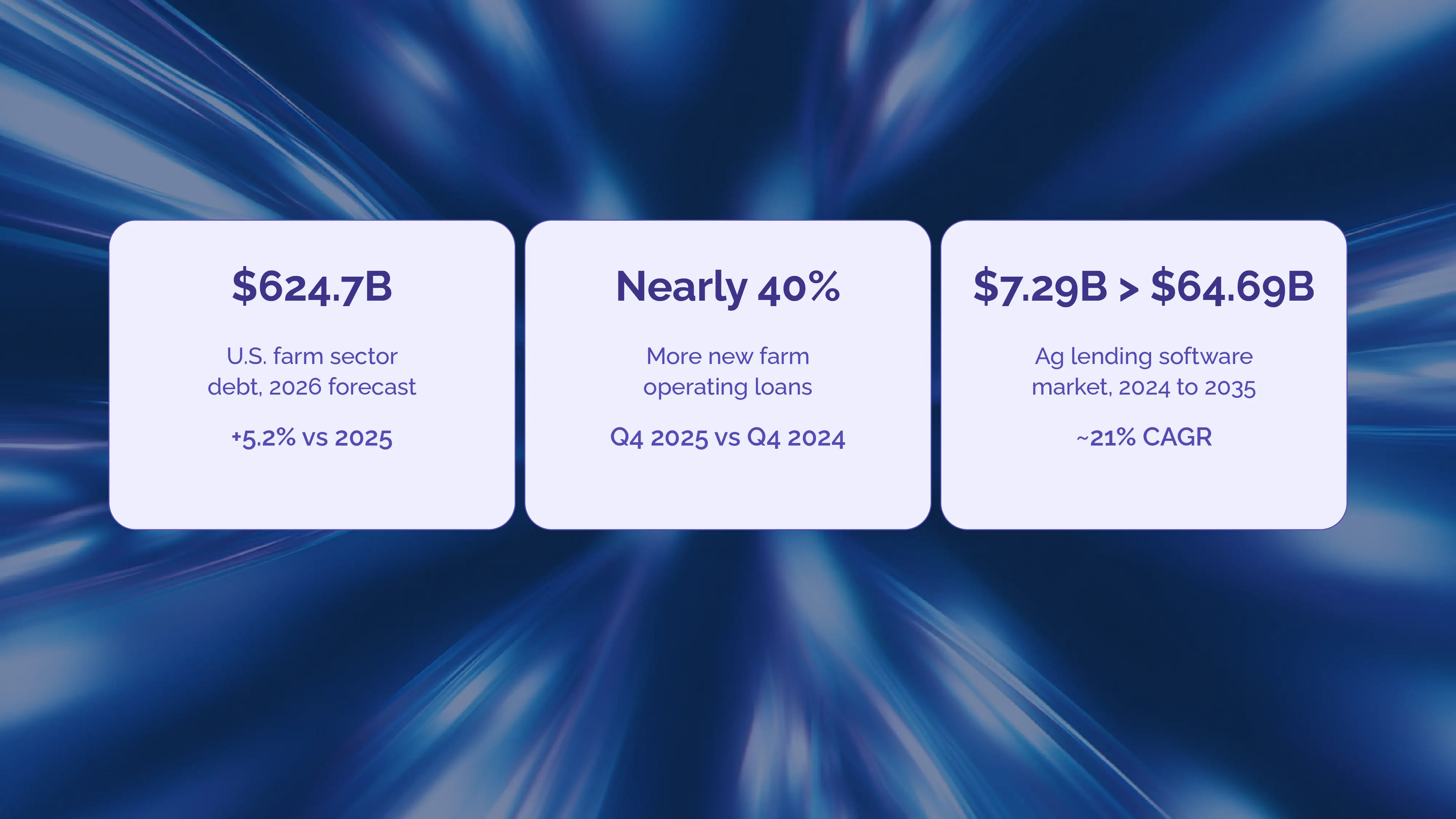
The market building software for this is growing just as fast, projected to climb from $7.29 billion in 2024 to $64.69 billion by 2035, a compound annual growth rate of about 21 percent, according to Research and Markets.
Solving for Process Debt in Legacy .NET Lending Platforms
We use the term “process debt” the same way across every legacy modernization project: every workflow step that still needs a human to shepherd it through the system adds a hidden, recurring cost. A 10-year-old lending platform accumulates this debt one workaround at a time.
What process debt looks like in manual underwriting workflows
New loan products get bolted on as special cases instead of modeled properly, because nobody wants to touch the underwriting engine that already works well enough. Every exception an underwriter learns to handle manually becomes tribal knowledge that lives in someone's head instead of in the system.
That's fine until the person who knows the workaround leaves, or until an examiner asks why two loans with identical risk profiles were underwritten differently. At that point, process debt stops being an efficiency problem and becomes a compliance one.
Modernizing without a rip-and-replace rebuild
A full rebuild sounds appealing until you price out the migration risk on a platform that's still processing live loans every day. The better path is usually a structured review: identify the weakest parts of the codebase, restructure the architecture around clear service boundaries, and automate what used to be manual deployment steps.
See it in practice: we reviewed the entire codebase of a decade-old commercial mortgage servicing platform and restructured the architecture for better stability and performance. We also built a Pulumi-based CI/CD pipeline to replace a manual deployment process that had accumulated its own workarounds over 10 years.
Not sure where your team stands on any of this? Let's discuss your business needs.
Get in touch →Fixing the Sync Data Problem: ERP and Banking Partner Integration
The second recurring pain point we see in agricultural lending platforms is what we call “sync data”: loan information that drifts out of alignment with the banking partners and ERP systems it's supposed to mirror. It usually starts small, a batch export that runs a few hours late, and compounds from there.
Why loan data drifts out of sync with core banking and ERP systems
Point-to-point integrations built one banking partner at a time create a different sync pattern for every relationship, and nobody owns the job of keeping them consistent. Batch exports run on a fixed schedule instead of firing on events, so a change made at 2 p.m. might not reach the ERP until the next morning's job runs.
Manual reconciliation fills the gap for a while, until loan volume grows past what a person can check by hand. That's usually the point where a sync gap turns into an audit finding.
Event-driven integration patterns that keep systems reconciled
Azure Service Bus handles the reconciliation events well: instead of a nightly batch job, each loan data change publishes an event that banking partners and ERP systems can consume as it happens. Idempotent sync jobs matter just as much, because a message that gets delivered twice after a network hiccup shouldn't create a duplicate transaction.
The goal is a single source of truth for loan state, with every downstream system treated as a subscriber rather than a second copy of the data. That's the same decoupling principle that keeps any high-volume backend reliable, applied to financial data instead of sensor data.
Credit Scoring and Underwriting Architecture for Agricultural Lending Software Development
Credit scoring for farm operations pulls from data sources a generic consumer lending model never touches. The architecture needs to accommodate that without turning the scoring engine into a black box nobody can explain to an examiner.
Where alternative agricultural data fits into credit models
Yield history, crop insurance claims, land value, and equipment age all carry real signal for farm credit risk that a standard credit bureau score misses. Pulling that data in cleanly means treating it as structured input to the scoring model rather than a manual underwriter note attached after the fact.
Keeping scoring logic auditable and explainable
Every score needs a documented decision trail: which inputs were used, what weight each carried, and what version of the model produced the result. Regulators expect that trail to exist before they ask for it, not after.
Audit Trails and Compliance by Design
None of this works if the audit trail is a logging library added in month eleven of a project. It has to be a schema-level decision made before the first loan record is written.
What examiners now expect from non-core lending systems
In April 2026, the OCC, the Federal Reserve, and the FDIC replaced prior model risk guidance with a new risk-based framework that explicitly covers AI tools supplied by vendors, according to the ABA Banking Journal. Every credit scoring or fraud detection model a lender runs now requires documented governance: where the model runs, who owns the environment, and how the institution can prove it has control over it.
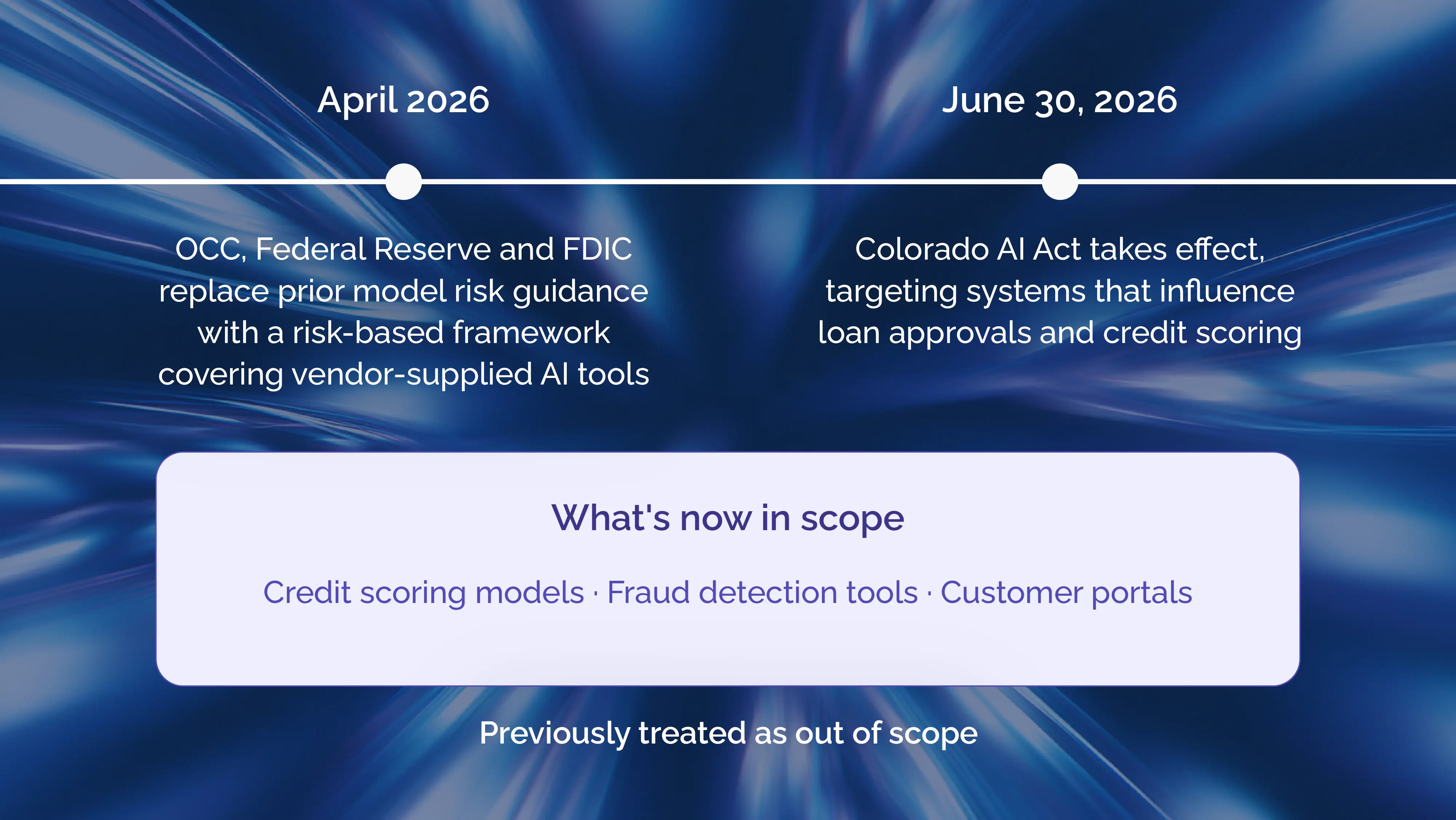
That scope now extends past the core risk program into the systems built around it, like customer portals and fraud tools, which examiners previously treated as out of scope. For agricultural lenders running a legacy .NET platform with bolted-on scoring logic, that's the gap most likely to surface in the next exam cycle.
Designing an audit trail that survives a real examination
Application Insights paired with a dedicated audit container, the same pattern used in the mortgage servicing platform referenced earlier, captures who changed what and when without slowing down the transaction path. Every write should carry the authenticated user's identity through Microsoft Entra, rather than a generic service account that makes every action look identical in the log.
Data Architecture for Financial-Grade Reliability
Database choices and access control decisions are where financial-grade reliability either gets built in or gets left as a gap. Neither is a place to guess.
Database choices for transactional integrity: SQL Server, Cosmos DB, and when to use each
SQL Server remains the right choice for the transactional core, the ledger, and anywhere strict relational integrity matters more than horizontal scale. Cosmos DB fits high-volume document and event data, like the financial statement ingestion and audit event streams a servicing platform generates continuously.
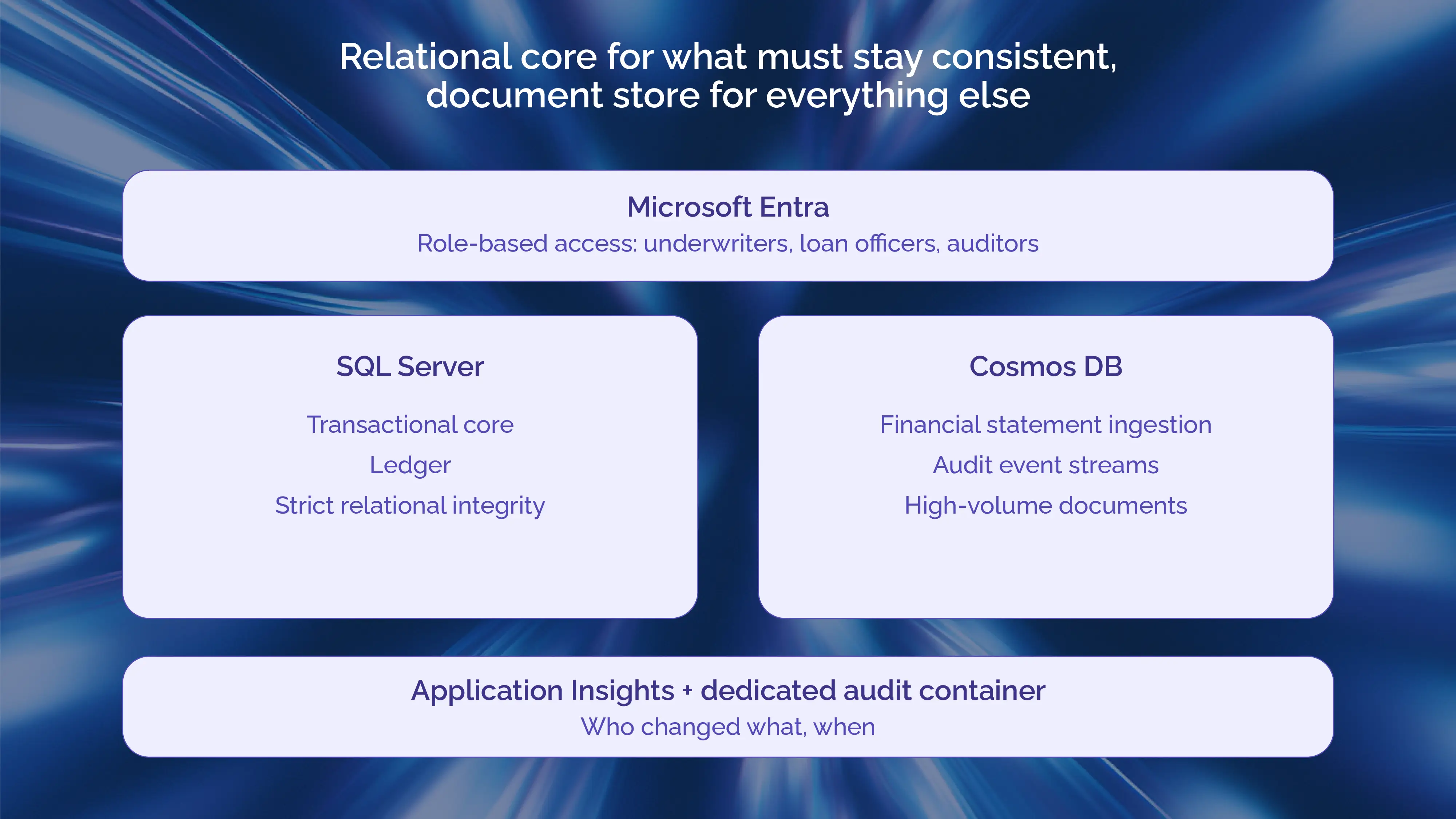
This pairing is common in financial-grade .NET systems, and it mirrors the storage split we recommend for any high-volume backend: a relational core for the data that has to stay perfectly consistent, and a document or event store for everything else.
Identity, access control, and Microsoft Entra
Underwriters, loan officers, and auditors need different access levels, and that distinction belongs in the identity layer rather than in application-level if-statements scattered across the codebase. Microsoft Entra handles role-based access consistently across every service that touches loan data, which keeps the access model auditable in the same place the audit trail already lives.
Final Thoughts
The architecture in this article gets a lending platform to financial-grade today. Here's where we think compliance and integration requirements are headed next.
Vendor AI governance will become a standard RFP line item within the next year
Following the April 2026 OCC, Federal Reserve, and FDIC framework, we expect agricultural lenders to start requiring documented AI governance from every fintech vendor they evaluate, including vendors that don’t sell AI-labeled products. That shift alone will change how vendor due diligence gets scoped over the next 12 months.
State-level AI regulation will start reaching lending platforms beyond Colorado
The Colorado AI Act, which took effect June 30, 2026, targets high-risk systems that influence loan approvals and credit scoring specifically, according to the ABA Banking Journal. We expect that pattern to spread to additional states by 2027, layering state requirements on top of the federal framework rather than replacing it.
Non-real-estate farm debt growth will keep pushing lenders toward faster underwriting
Non-real-estate farm debt is forecast to grow 6.0 percent in 2026, according to the USDA Economic Research Service, a faster pace than real estate debt growth in the same forecast. That pace of operating-loan demand rewards lenders whose systems can underwrite quickly while keeping the audit trail intact.
Financial-grade means the audit trail, the sync logic, and the scoring model all hold up under real scrutiny, without the platform grinding to a halt every time a new banking partner or ERP integration comes online.
A few questions come up in almost every conversation we have with fintech teams building on legacy .NET lending platforms. Here are direct answers to the ones we hear most.
FAQs
-
What makes agricultural lending software different from generic loan origination platforms?
Farm credit follows a seasonal cash flow tied to the harvest calendar, uses land and equipment as collateral, and depends on agricultural data sources, like yield history and crop insurance records, that generic consumer or commercial lending platforms don't ingest.
A financial-grade agricultural lending software platform needs to model that seasonality and those data sources directly, rather than force farm credit through a workflow built for steady monthly repayment.
-
How do you keep loan data synced between a lending platform and ERP or banking partner systems?
Event-driven integration, where a loan data change publishes an event that downstream systems consume as it happens, keeps data reconciled without relying on nightly batch jobs or manual checks. Idempotent processing on each subscriber prevents a redelivered event from creating a duplicate transaction.
-
What compliance requirements apply to AI-assisted credit scoring in agricultural lending?
Since April 2026, federal banking regulators require documented governance for any AI model used in credit scoring or fraud detection, including vendor-supplied tools, covering where the model runs and who can prove control over it.
Colorado has separately begun regulating AI systems that influence loan approvals, and other states are moving in the same direction, so the compliance requirements now layer federal and state rules together.
-
Can a legacy .NET lending platform be modernized without a full rebuild?
Usually, yes. A structured codebase review that restructures the weakest architectural boundaries and automates deployment tends to carry less risk than a full rewrite, particularly for a platform that's still processing live loans.