Irrigation Monitoring Software Development: How to Design a Scalable .NET Backend for Real-Time Sensor Data
8/21/2026
By: Devessence Inc
A soil moisture probe doesn't care whether your backend is ready for it. It reports every few minutes, connection or no connection, whether it's the first sensor on the network or the ten-thousandth. Most irrigation monitoring software development projects start with an idea proven out on a handful of sensors across one or two demo farms.
Then the pilot ends. Sensor counts climb into the thousands, connectivity gets patchy, and customers expect their dashboards to update in seconds, not minutes. The architecture that got the team through the demo usually can't keep up.
In our new article, we will discuss how to design a .NET backend on Azure that can take irrigation monitoring software from a pilot deployment to a multi-tenant, production-grade platform without a rebuild along the way. We'll cover the ingestion layer, storage, real-time processing, and the connectivity problems that are specific to field agriculture rather than generic IoT.
Key Takeaways
- Decoupling ingestion, processing, and storage into independently scalable components is the single architectural decision that determines whether a platform survives the jump from pilot to production.
- Azure IoT Hub handles device identity, authentication, and bi-directional communication, but you still need a separate strategy for stream processing and long-term storage.
- Device twins let engineering teams track and update configuration and firmware state across a large sensor fleet without manual, per-device intervention.
- Keep full-resolution time-series data for a defined window, commonly around 90 days, then downsample or archive it, because storing everything at full resolution forever doesn't scale economically.
- Store-and-forward buffering at the edge is mandatory for irrigation deployments, since sensors sit in rural areas with spotty cellular or satellite connectivity, and a backend that assumes constant uptime will lose data.
The Irrigation Monitoring Software Architecture Challenge
Before you pick a single Azure service, it helps to understand why this workload behaves so differently from a typical business application. Two forces drive most of the design decisions below: load pattern and geography.
Why irrigation telemetry breaks naive architectures
Irrigation sensor networks don't behave like a typical SaaS application. Traffic isn't steady, and it spikes hard during the growing season before dropping off almost to nothing over winter. Size the architecture for peak load, and it sits mostly idle for months; size it for the average, and it falls over exactly when farmers need it most.
Geography makes this worse. Sensors sit in fields miles from the nearest cell tower, and connectivity that looks fine on a spec sheet turns out to be intermittent in practice. A backend built around the assumption that every device is always reachable will lose data silently the first time a gateway drops offline for an hour.
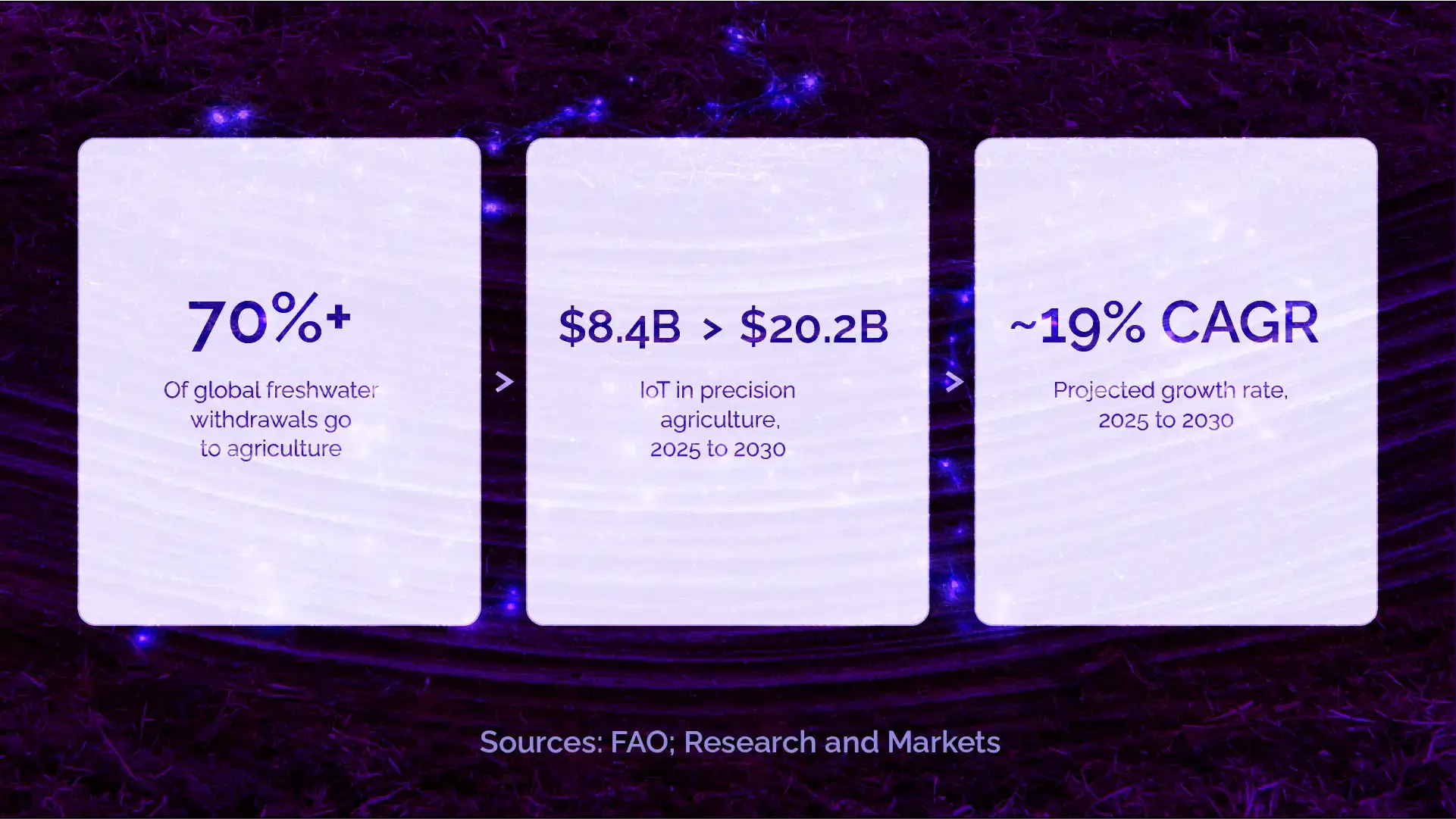
The stakes are bigger than they look at first glance. Agriculture accounts for more than 70 percent of global freshwater withdrawals, according to the Food and Agriculture Organization of the United Nations, which is precisely why irrigation software exists: even small improvements in scheduling accuracy translate into real water savings at scale.
The market reflects that demand. The IoT-in-precision-agriculture market was valued at roughly $8.4 billion in 2025 and is projected to reach $20.2 billion by 2030, according to Research and Markets, a compound annual growth rate of about 19 percent.
Teams building here aren't building a niche tool. They're building infrastructure for a market that's compounding fast.
Real platforms already operate at this scale. CropX combines proprietary soil sensors with cloud-based analytics and reports deployments in more than 60 countries, according to its own product announcements. Netafim's NetBeat platform manages automated irrigation and fertigation by integrating sensor and analytics data from partners like Arable, per the companies' own integration announcement.
Designing the Ingestion Layer for Irrigation Monitoring Software Development
Once you understand the load pattern, the next question is mechanical: how do sensors actually get data into the cloud, and how do you keep that pipeline from becoming a single point of failure? The next two sections cover ingestion and the decoupling pattern that makes it scale.
Choosing the ingestion layer: Azure IoT Hub vs. raw MQTT
How do devices get data into the cloud in the first place? That's the first real architectural decision, and Azure IoT Hub is purpose-built to answer it. It supports MQTT, AMQP, and HTTPS out of the box, so field hardware doesn't need custom protocol handling to talk to it, and it manages device identity through X.509 certificates or SAS tokens instead of leaving authentication to something bespoke.
You could stand up your own MQTT broker instead, and for a narrow use case, that might even be simpler on day one. Here's what IoT Hub buys back once a fleet grows past a few hundred devices: device provisioning at scale through the Device Provisioning Service, direct methods for cloud-to-device commands, and device twins.
Device twins are especially important for irrigation hardware, because field sensors drift. Firmware versions fall out of sync, calibration settings need periodic updates, and a technician can't physically visit every unit to fix it.
A device twin stores desired and reported properties for each device in the IoT Hub identity registry, so a backend can push a configuration change to 5,000 sensors and check, per device, whether it landed. No support ticket, no truck roll.
Azure IoT Hub's Standard S1 tier handles 400,000 messages per unit per day, according to Microsoft's own documentation, and that quota scales linearly by adding units or moving to a higher tier. For a platform in early commercial rollout, that's enough headroom to plan sensor growth in a spreadsheet instead of guessing at it.
Decoupling ingestion from processing
The most common failure mode in an irrigation backend is a single process trying to do everything: it reads MQTT messages, validates them, writes to a database, and serves the dashboard API, all in one deployable unit. When telemetry volume spikes during peak irrigation season, that whole process has to scale, including the parts that have nothing to do with ingestion.
IoT Hub's built-in Event Hub-compatible endpoint fixes this by giving downstream consumers an independent point to read from. Instead of one .NET application owning the whole pipeline, split it into separate Worker Services, each responsible for one concern: a telemetry ingestion worker that validates and forwards messages, a processing worker that applies business logic, and an API layer that only ever reads from storage.
Each one scales on its own metrics. The ingestion worker scales with message volume, and the API scales with dashboard traffic, so the two don't have to rise and fall together.
This adds upfront complexity, and it pays for itself the first time you need to add a new consumer, such as an anomaly-detection pipeline, without touching the code that's already reliably ingesting telemetry.
Scoping an Azure or .NET build for irrigation monitoring? We'd love to hear about it. Tell us about your sensors and timeline, and we'll help you find the right architecture.
Contact us →Processing and Storing Data for Irrigation Monitoring Software
Getting messages into Azure is only half the job. The next decisions are where real-time logic runs and how you keep years of sensor readings queryable without the bill or the latency getting out of hand.
Real-time processing: Stream Analytics, Azure Functions, or a custom .NET consumer
Once messages are flowing through Event Hubs, where does the actual logic live? That's the code that decides a soil moisture reading is too low, or that a flow sensor is reporting a spike consistent with a burst pipe.
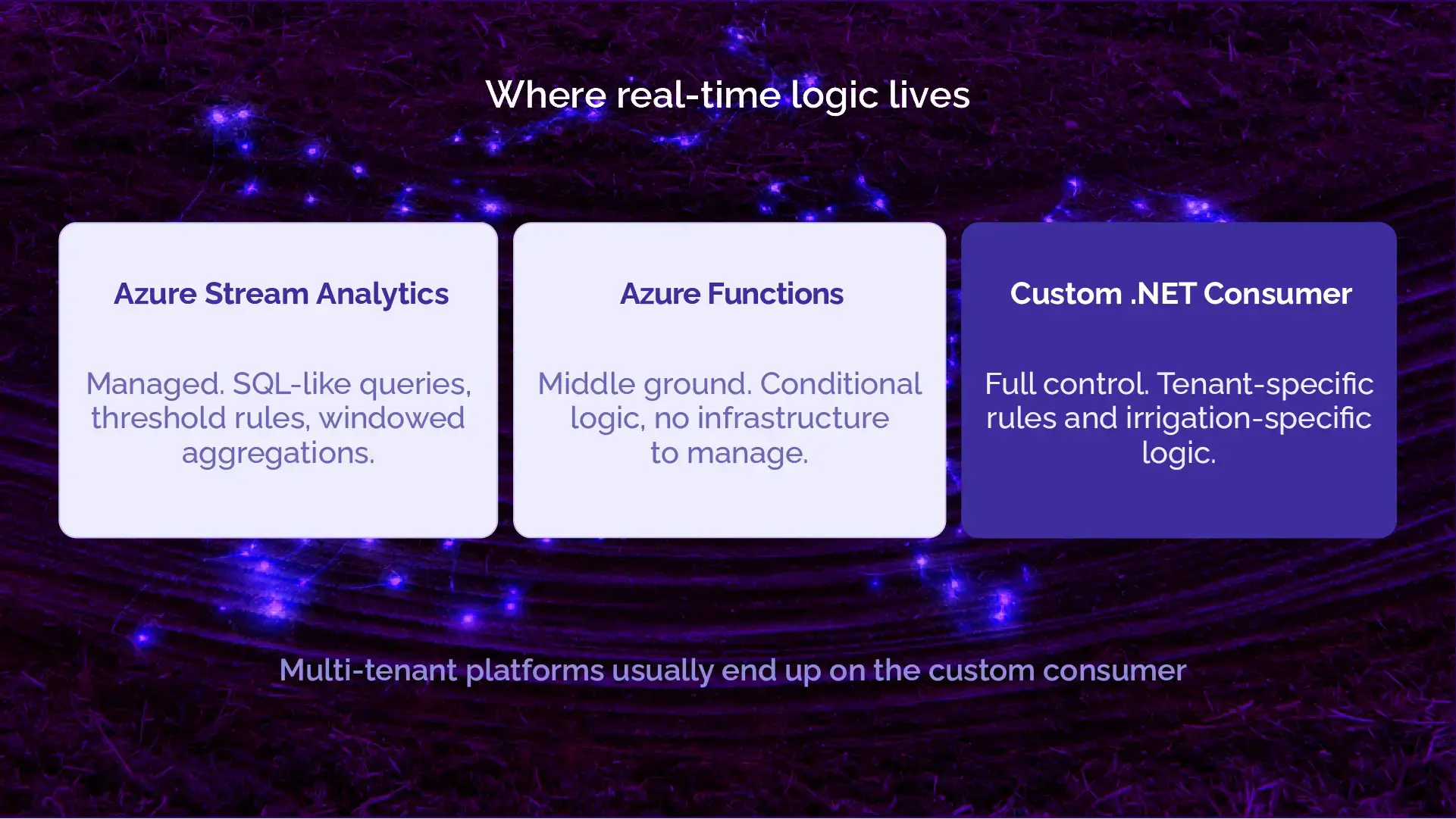
Azure Stream Analytics is the managed option: a SQL-like query language running continuously over the event stream, well suited to threshold rules and windowed aggregations. Azure Functions triggered off Event Hubs sits in the middle, giving more flexibility for conditional logic without managing infrastructure.
A custom .NET consumer built as a hosted background service is the right call once the logic gets specific to irrigation: correlating soil moisture with a farm's crop type, weather forecast, and irrigation zone configuration, for instance, or routing alerts differently depending on which tenant's rules apply.
In our experience, multi-tenant platforms almost always end up on the custom consumer, because tenant-specific alerting and routing logic don't map cleanly onto a generic managed service.
Storage strategy for time-series sensor data
Sensor telemetry is time-series data. Treat it like ordinary relational data, and you'll run into trouble as table sizes grow. A purpose-built time-series store, whether that's Azure Data Explorer, a managed InfluxDB or TimescaleDB instance, or something similar, handles high-frequency writes and range queries far more efficiently than a general-purpose relational table ever will at scale.
Relational storage still has a role, though. Device metadata, farm and zone configuration, tenant records, and user accounts are all naturally relational, and they belong in a standard SQL database. The pattern that works well pairs a time-series store for the raw telemetry stream with a relational store for everything that describes the fleet and its owners.
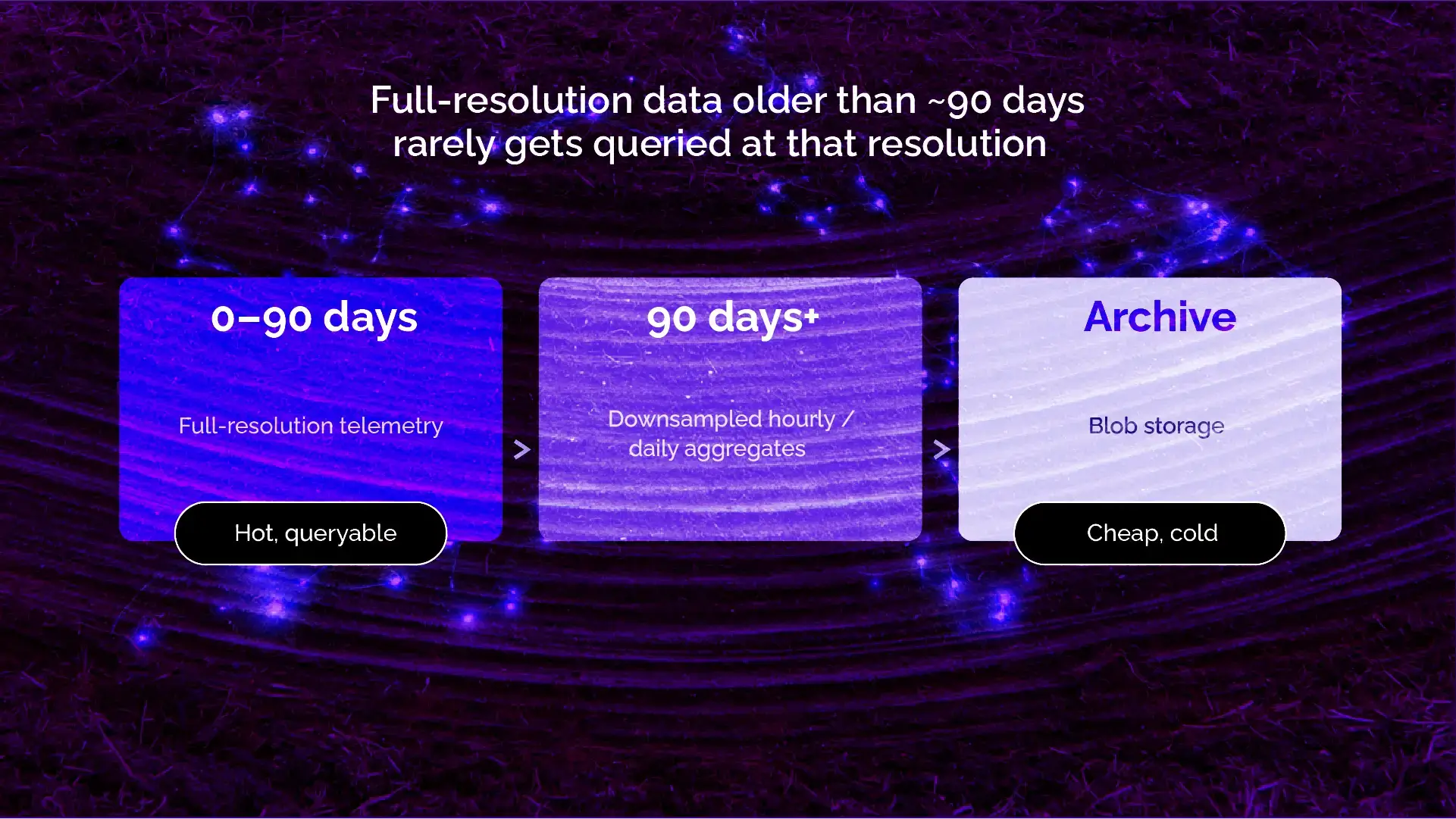
Retention strategy matters just as much as the choice of database. Full-resolution readings older than about 90 days rarely get queried at that resolution again, so archive them to cheaper blob storage and serve longer-range queries from downsampled hourly or daily aggregates.
Structured, searchable data at scale isn't unique to irrigation. See it in practice: we digitized two decades of internal turbine blade inspection reports into a searchable, ML-ready dataset for Siemens Gamesa Renewable Energy, turning thousands of unstructured PDFs into a structure that scales, the same underlying problem this article is solving for irrigation telemetry.
For a multi-tenant platform, data isolation adds another decision: separate schemas per tenant, or shared tables with row-level security enforced in the .NET data layer? We covered this trade-off in depth in our precision agriculture SaaS architecture piece, which walks through how that decision plays out for a multi-tenant platform built on the same kind of sensor telemetry.
Handling Field Conditions
None of the architecture above matters if it assumes perfect connectivity, and irrigation deployments rarely get that. This section covers the buffering and ordering logic that keeps rural, intermittent networks from becoming permanent data loss.
Designing for unreliable field connectivity
Most generic IoT architecture guidance assumes devices stay reliably connected, and that assumption breaks down across most farmland. Store-and-forward buffering at the edge, where a gateway holds telemetry locally and retries transmission once connectivity returns, is what keeps a network outage from becoming permanent data loss.
That buffering creates its own backend problems. Messages can arrive out of order, and the same message can arrive twice after a retry.
A production ingestion layer needs to timestamp each reading at the point of capture, since that's what lets it reconstruct correct ordering later. It also needs idempotency keys to catch and drop duplicates before they reach storage.
Then there's backpressure. When a gateway reconnects after hours offline, it can flood the ingestion layer with a backlog of buffered messages all at once, and if the ingestion layer can't absorb that burst, the whole point of buffering is lost. This is another reason the decoupled architecture from earlier matters: a queue between ingestion and processing gives the system somewhere to put a burst of backlog while it catches up.
The .NET Backend Layer
Above the ingestion and processing layers sits the application that farmers, agronomists, and operations teams actually use every day. The next two sections cover the API and real-time layer, then the security posture that layer needs.
The application and API layer
This layer includes a REST or GraphQL API serving the web dashboard and mobile app, background workers handling scheduled tasks like daily usage reports, and a real-time layer pushing live updates without the client polling for them. ASP.NET Core Web API remains a solid default here, with Worker Service or IHostedService implementations handling the background processing described earlier.
For pushing live sensor readings to a dashboard the moment they arrive, SignalR gives you a straightforward way to maintain persistent connections without building that infrastructure from scratch.
Microsoft's own work with SunCulture in Kenya is a useful reference point: the platform processes soil moisture and pump efficiency data alongside a network of more than 2,000 hyperlocal weather stations, all within Azure, to deliver real-time irrigation recommendations by text message. It's the same shape of problem as this article, many distributed sensors feeding a cloud backend that delivers a simple result, just at a scale most teams are building toward rather than starting from.
Security and compliance considerations
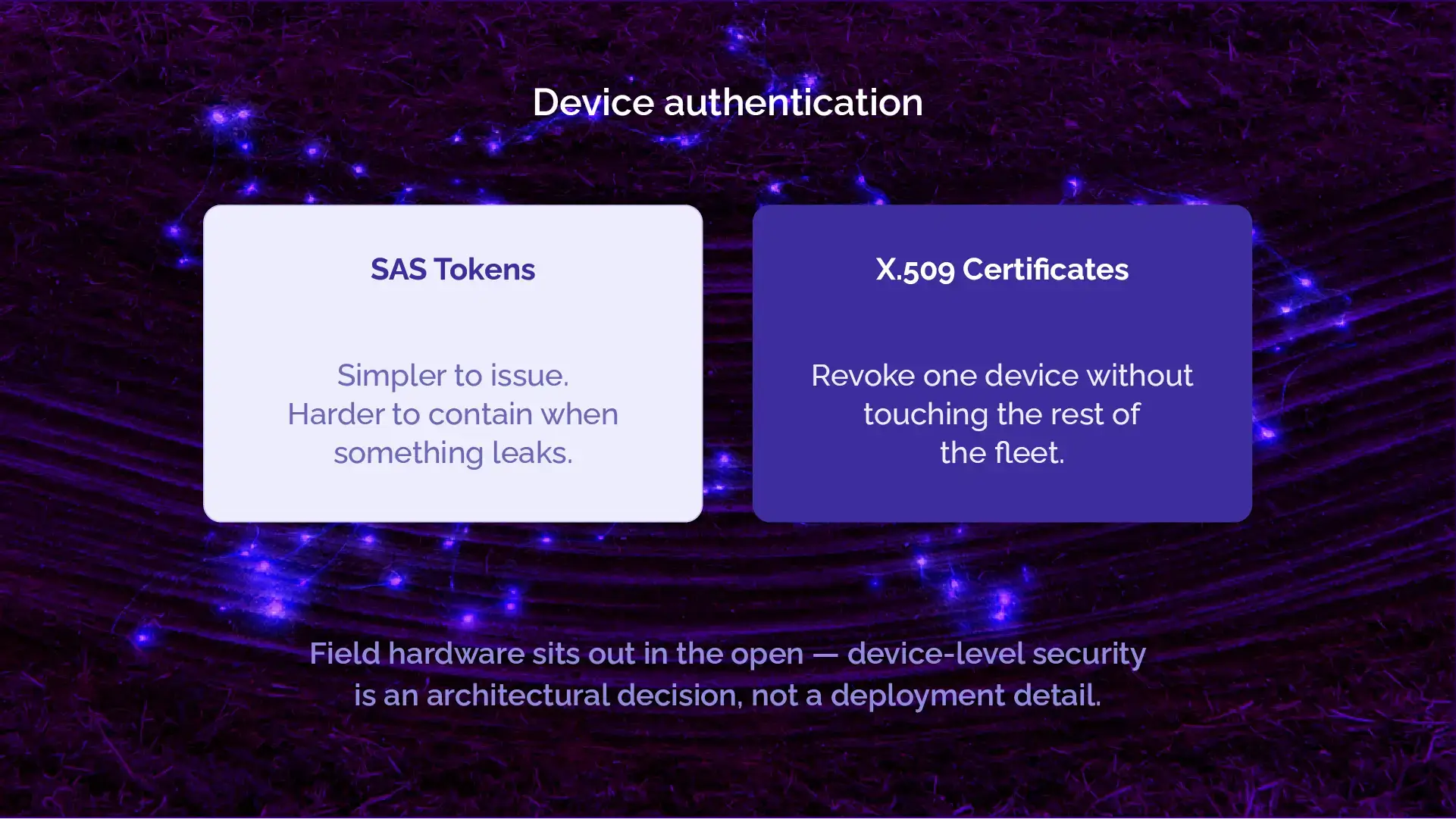
Field hardware sits out in the open in a way data center equipment never does, which makes device-level security a first-class architectural concern from the first design review. X.509 certificate-based authentication beats SAS tokens for production fleets, since a compromised certificate can be revoked per-device without touching the rest of the fleet.
Encrypt data both in transit, which IoT Hub handles by default over TLS, and at rest in whichever storage layer holds it. If you're selling into enterprise agribusiness customers, compliance expectations around data residency and access auditing tend to show up earlier than founders expect, and designing the tenant isolation and access-logging layers with that in mind from the start costs considerably less than retrofitting it after a security review flags the gap.
Final Thoughts
The architecture in this article gets a platform through its first production rollout. Here's where we think the underlying tools are headed over the next few years.
Event Grid namespaces will simplify simpler topologies within the next year or two
Microsoft has been steadily extending Event Grid's namespace features to cover more of the ground that used to require a separate Event Hubs instance. For irrigation platforms with simpler routing needs, we'd expect that convergence to reduce the number of distinct Azure services a small engineering team needs to operate, without giving up the decoupled architecture this article recommends.
Edge AI will absorb more anomaly detection by 2027
As sensor fleets grow into the tens of thousands, pushing simple anomaly detection onto edge gateways, rather than sending every raw reading to the cloud for evaluation, will become standard practice for cost reasons alone. Expect more irrigation platforms to ship lightweight on-device models that flag likely anomalies locally and escalate only the readings that actually warrant cloud-side analysis.
Multi-tenant SaaS delivery will keep displacing per-farm custom builds
As the precision agriculture market consolidates, buyers increasingly expect to subscribe to a platform rather than commission a bespoke one. Teams that build multi-tenancy into their irrigation monitoring software architecture now, instead of bolting it on after their first few customers, will be the ones positioned to win as that shift accelerates over the next three to five years.
Designing an irrigation monitoring backend that holds up past the pilot stage takes the same architectural discipline as any large-scale IoT system. What's different is agriculture itself: seasonal load, rural connectivity, and customers who need the platform to just work in the field, every day, without a data center engineer nearby to fix it.
Ready to design your backend?
If your team is scoping a build on Azure and .NET, Devessence's Microsoft Azure Engineering group works with agtech and precision-ag companies on exactly this kind of architecture, from initial design through production scale. Reach out to talk through your sensor volume and rollout timeline, and we'll help you map the right architecture from day one.
FAQs
-
What's the difference between MQTT and Azure IoT Hub?
MQTT is a lightweight messaging protocol; Azure IoT Hub is a managed service that speaks MQTT, AMQP, and HTTPS while also handling device identity, provisioning at scale, and device twins. A raw MQTT broker can be simpler for a small pilot, but you'll likely rebuild most of what IoT Hub already provides once the fleet passes a few hundred devices.
-
What is a device twin, and why does it matter for irrigation sensors?
A device twin is a cloud-side record of a device's desired and reported configuration, stored in the IoT Hub identity registry. For irrigation hardware specifically, it lets you push firmware and calibration updates to thousands of field sensors and confirm, per device, that the change landed, without a truck roll.
-
Should sensor data go into a time-series database or a relational database?
Both, typically. Raw telemetry belongs in a purpose-built time-series store, such as Azure Data Explorer, InfluxDB, or TimescaleDB, while device metadata, tenant records, and farm configuration belong in a standard relational database, since that data is naturally relational rather than time-ordered.
-
How much does custom irrigation monitoring software cost compared to an off-the-shelf platform?
The honest answer is that it depends on sensor count, integration scope, and how much multi-tenant infrastructure you need, and we won't quote a number without knowing those specifics. What we can say is that the biggest cost driver is usually not the cloud services themselves but the engineering time spent on the ingestion and storage architecture described in this article, so getting that right early is what keeps the total cost predictable as you scale.