According to IBM’s 2026 Cost of a Data Breach Report, healthcare breaches cost more than those in any other industry, at an average of $6.64 million per incident. On the other hand, Verizon’s 2026 Data Breach Investigations Report found that exploiting known vulnerabilities is now the most common way into a breached network.
Many budgets still treat maintenance as the line to trim when money gets tight. The bill arrives later as breach response, downtime, regulatory exposure, and clinicians waiting on slow systems.
In our new article, we’ll discuss what delayed updates cost in four areas: breaches, downtime, compliance penalties, and clinician productivity. We’ll also talk about how to turn those numbers into a maintenance budget your finance team can approve.
Key Takeaways
- Healthcare breaches are the most expensive of any industry, at $6.64 million on average in IBM’s 2026 data.
- Vulnerability exploitation is the largest single entry point into healthcare breaches, at 20% in Verizon’s 2026 report.
- Patching is slowing down. The median time to fully fix a vulnerability rose from 32 to 43 days.
- Ransomware downtime cost US healthcare organizations about $1.9 million per day, and attacks averaged more than 17 days of disruption (Comparitech).
- HIPAA already requires risk analysis and risk management. A proposed Security Rule overhaul would add defined remediation timeframes, and HHS now targets July 2027 for final action.
- Clinician time is the hardest cost to see. In 80% of organizations KLAS measured, fewer than 70% of clinicians said their EHR responds quickly.
- Four inputs your finance team can check to build the business case: patch time, unplanned downtime hours, cost per hour of downtime, and clinician minutes lost.
The Numbers at a Glance
There are five of the most important numbers you need to know to see the full picture here.
- $6.64 million is the average cost of a healthcare data breach, the highest of any industry, down from $7.42 million a year earlier (IBM)
- 20% of healthcare breaches began with vulnerability exploitation, the largest single entry point; across all industries, the share is 31% (Verizon DBIR)
- 43 days is the median time to fully patch a vulnerability, up from 32 days the year before (Verizon DBIR)
- $1.9 million per day is the estimated cost of downtime after a ransomware attack on a US healthcare organization (Comparitech)
- 80% of the organizations KLAS measured had fewer than 70% of clinicians saying their EHR responds quickly (KLAS Arch Collaborative)
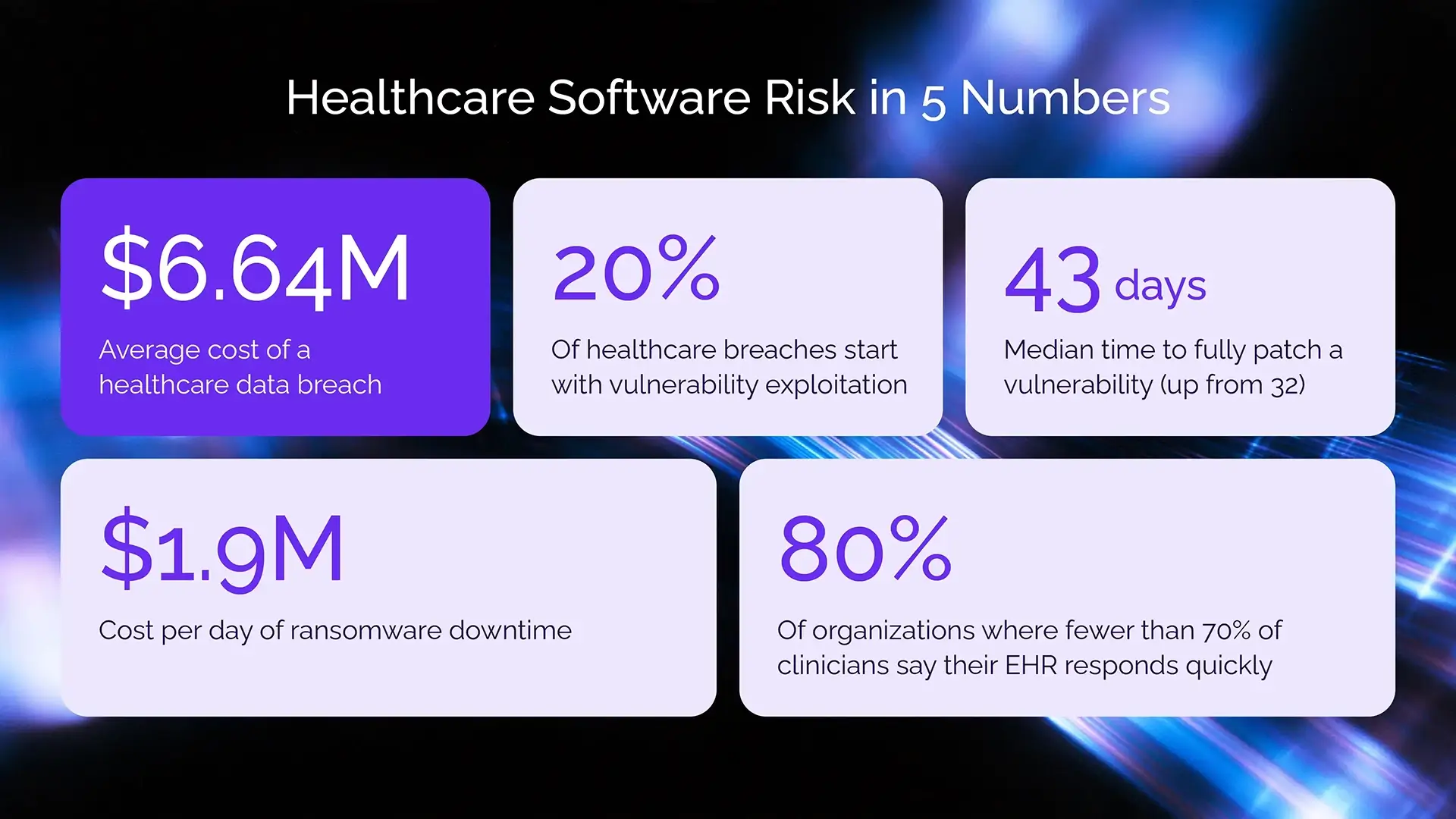
All five figures describe the sector as a whole. None of them describe your organization, so a later section walks through a way to calculate your own.
Why Healthcare Teams Delay Updates
Nobody delays an update because they like risk. Clinical systems run around the clock, and a failed update can take a medication workflow offline during a shift change.
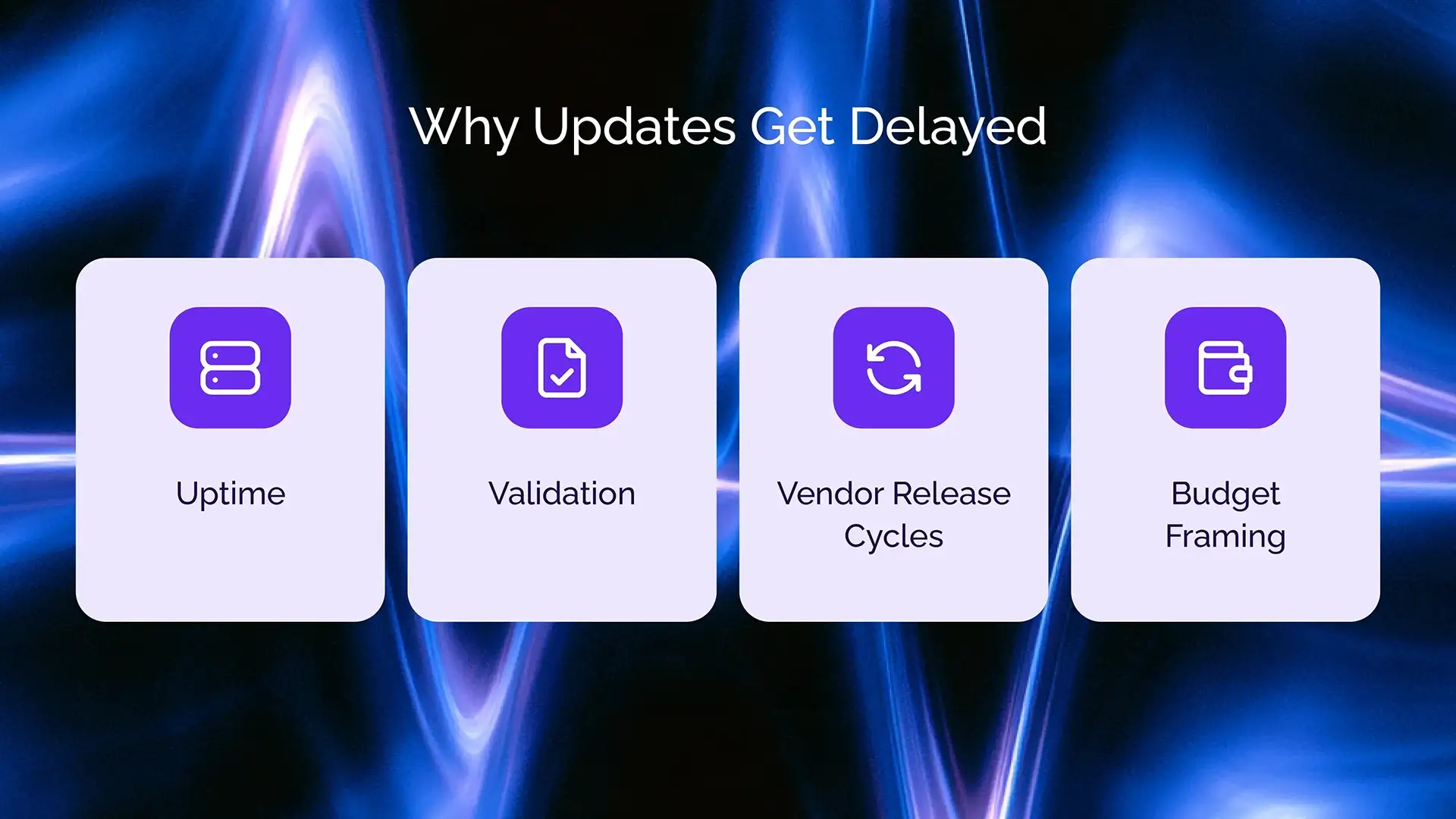
In our experience, four pressures push maintenance down the list. Uptime comes first, because finding a maintenance window for a system that clinicians use at 3 a.m. takes real negotiation. Validation comes second, since every change to a clinical system needs testing before anyone trusts it.
Vendor release cycles add a third pressure. When an EHR vendor certifies only certain versions of a database or runtime, the whole stack waits on that schedule.
Budget framing is the fourth. A new patient app has a launch date and a champion, while a patch has neither.
What Counts as a Delayed Software Update?
We use the term broadly. An update is delayed when a fix, version, or standard is available, and the vendor supports it, yet your systems still don’t run it.
Here are the main categories:
- Security patches: fixes for operating systems, databases, and application dependencies.
- Framework and runtime upgrades: moves to supported versions of platforms such as .NET.
- Vendor and EHR releases: new versions from the vendors whose products your clinicians use every day.
- Interoperability updates: newer FHIR versions and API changes from partners and payers.
- Infrastructure components: certificates, libraries, and cloud services nearing end of life.
A dated deadline shows how this plays out. Microsoft ends support for .NET 8 and .NET 9 on November 10, 2026, which means no more security fixes or technical support for either version after that date. Microsoft recommends upgrading to .NET 10, which has support through November 2028.
Any patient portal, integration service, or internal tool still on those versions the next day will sit in the same position as an unpatched system. The next vulnerability gets a fix for supported versions only. That deadline is weeks away.
The Four Costs of Delaying Updates
Each cost below has its own source, its own limits, and its own owner inside a health system. We give the number, say what it includes, and flag where the data stops.
Breach costs
Verizon’s 2026 data shows vulnerability exploitation as the largest single way into healthcare breaches, at 20%. Across all industries, it reached 31%, which put it ahead of stolen credentials for the first time in the report’s 19-year history.
Once attackers get in, the bill grows with every day they stay. IBM’s 2026 report puts the average healthcare breach at $6.64 million, still the highest of any industry. That figure covers detection and escalation, notification, post-breach response, and lost business.
Two caveats apply. The IBM average covers breaches from every cause, so unpatched software explains only part of it. A lower average year over year also says nothing about whether your own exposure fell.
Insurance adds a second-order cost. Some organizations report steep premium increases after a breach.
Downtime
Downtime is where a security event becomes an operational one. Comparitech estimates that a day of downtime after a ransomware attack costs US healthcare organizations about $1.9 million on average, with attacks averaging more than 17 days of disruption.
That estimate includes restoring systems, specialist response teams, staff overtime, lost revenue, and identity protection for affected patients. It also rests on recovery costs disclosed by 15 organizations, so use it to size the problem and then run your own numbers.
The damage reaches beyond the hospital’s walls. A JAMA case study of four hospitals found that the two unaffected ones absorbed emergency patients from the two that were attacked and saw longer waits and more strain.
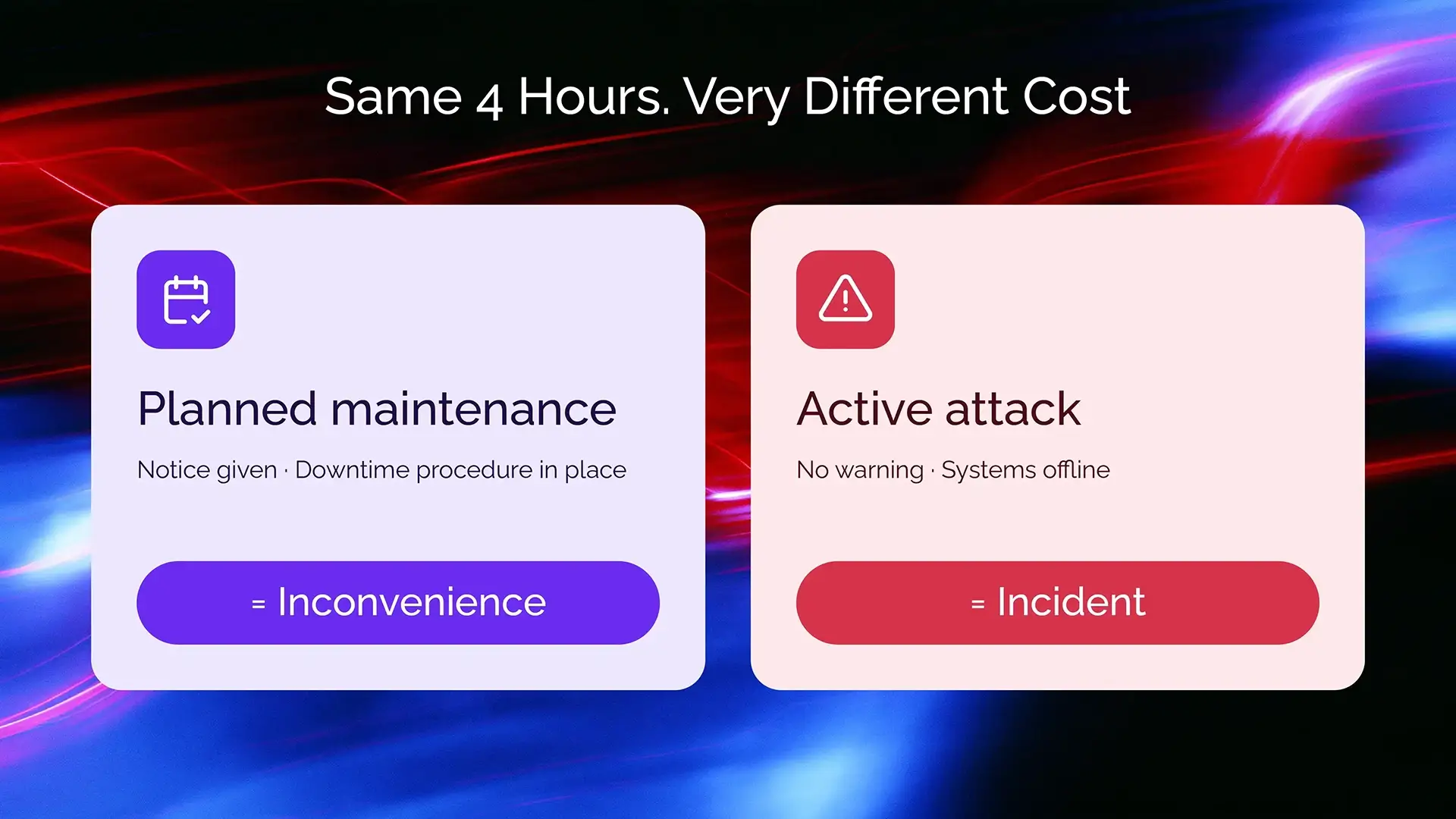
Planned downtime for patching costs far less than unplanned downtime from an exploit. A four-hour maintenance window with notice and a downtime procedure is an inconvenience. The same four hours during an active attack is an incident.
Compliance penalties
The current HIPAA Security Rule, finalized in 2003 and modified in 2013, requires covered entities and business associates to analyze the risks to electronic protected health information and manage the ones they find. A known, unpatched vulnerability is a risk that fits that description. OCR enforcement has often centered on risk analysis and risk management failures.
Penalties scale with culpability. HHS sets tiers based on how much the organization knew and what it did about it, and it adjusts the dollar caps for inflation each year. An organization that knew about a fix and didn’t apply it will have a hard time arguing it couldn’t have known.
More is coming. HHS proposed a Security Rule overhaul in January 2025 that would make all safeguards mandatory, define timeframes for remediating vulnerabilities, and require a technology asset inventory. As of mid-September 2026, no final rule had been published, and HHS now targets July 2027.
We’d plan to the proposed standard now. The direction is clear, and organizations that build the inventory and remediation process early will carry less of the cost when the compliance window opens.
A breach also triggers state notification laws and contract obligations to payers and partners, each with its own cost.
Clinician productivity loss
This cost rarely shows up on an invoice, which makes it the easiest to leave out. The KLAS Arch Collaborative’s 2025 report, which surveyed more than 600,000 clinicians, found that in 80% of the organizations it measured, fewer than 70% of clinicians said their EHR responded quickly.
The data doesn’t show how much of that slowness comes from delayed updates, and we won’t pretend it does. Aging runtimes, unpatched databases, and overloaded legacy services all slow systems down, and so do poor configuration and training.
What we can describe is how the cost behaves. When a system lags or freezes, clinicians take notes on paper, chart later, or batch their work after hours, and each workaround adds minutes to every shift. Multiply those minutes by headcount and a loaded hourly rate, and the figure gets large quickly.
Later in the article, we show how to calculate this cost with your own numbers.
Not sure which of these costs your systems face first?
Our team is happy to take a look.
Get in touch →Cost and ROI: What a Maintenance Budget Covers
A maintenance budget is the price of avoiding the four costs above. It’s easier to approve when you can say what it buys.
What maintenance spending includes
- Patching and dependency upgrades.
- Framework and runtime migrations, for example, .NET 8 to .NET 10.
- Automated regression tests that make each update safe to ship.
- Monitoring and alerting, so a failed update or an outage surfaces quickly.
- Release engineering and rollback plans.
- Documentation and an up-to-date inventory of every component.
We don’t offer a single percentage of build cost here, because no benchmark we trust fits every system. Your inventory gives a better starting point. Count the components, check each one’s support date, and price the work.
The hidden costs of waiting
- Compounding upgrades. A skipped version doesn’t go away. Each later upgrade covers more changes, which raises both the effort and the testing risk.
- Integration drift. Partner APIs, payer connections, and FHIR endpoints change on their own schedules, and an old integration can break without warning.
- Support cliffs. When a vendor ends support, you migrate under deadline pressure.
- Insurance and audit friction. Questions at renewal and during audits get harder to answer when the inventory shows out-of-support components.
When returns appear
Some returns come quickly. Closing known vulnerabilities and clearing audit findings shows up within weeks, while fewer unplanned outages and simpler upgrades take a few quarters.
Avoided breaches take the longest to prove, because nobody sees an incident that didn’t happen. Build the business case on exposure and measurable operating metrics, and treat avoided incidents as the upside.
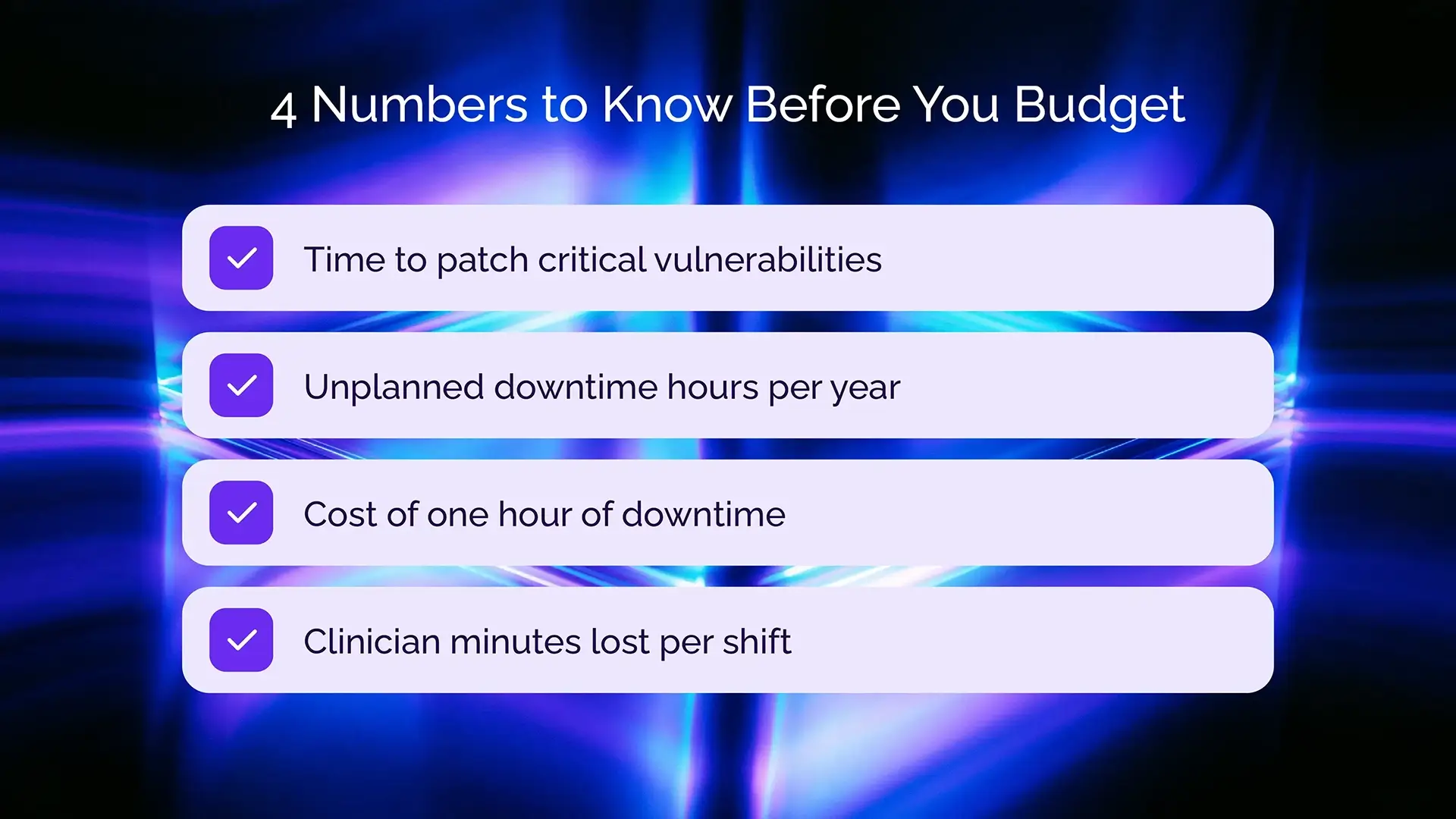
Four numbers to establish before you budget
- Time to patch critical vulnerabilities. Compare yours with the 43-day median in Verizon’s data.
- Unplanned downtime hours per year. Pull them from incident logs.
- Cost of one hour of downtime. Finance can usually build this from revenue, staffing, and diverted care.
- Clinician minutes lost to system friction per shift. A short survey of ten or twenty clinicians gives a usable estimate.
How to Build the Business Case for Maintenance
Knowing the four costs is half the job. The other half is getting a finance team to act on them. Let’s take a closer look at how to frame the numbers, which metrics to track, and how to put the request in front of your CFO or board.
Frame it as risk reduction
Finance teams already price risk. Give them the same structure: probability times impact, summed across the four costs.
Here’s an illustration with made-up inputs. A regional provider has 120 clinicians. It assumes a 5% annual chance of a breach at the IBM average of $6.64 million, which gives an expected loss of $332,000 a year.
It estimates eight hours of unplanned downtime a year at $40,000 an hour, or $320,000. It also assumes each clinician loses 10 minutes a day to slow systems across 230 working days, which comes to 4,600 hours. At a loaded rate of $150 an hour, that’s $690,000.
The total comes to about $1.34 million a year. A maintenance program won’t remove all of it. If it cuts that exposure by a third, the saving is about $447,000, which already exceeds a hypothetical $350,000 annual maintenance budget.
Swap in your own inputs, and challenge every assumption before you present it. Your CFO will.
Track the right metrics
- Median time to patch critical vulnerabilities.
- Share of critical vulnerabilities fixed within your own target.
- Unplanned downtime hours per quarter.
- Number of versions behind vendor-supported releases.
- Clinician-reported system speed.
Baseline all five now, then check again at 60 and 120 days. That window is long enough to see a trend and short enough to adjust.
Present it to your CFO or board
Lead with the exposure number and the support calendar, and show the maintenance line next to them. Ask for a standing budget line with a named owner, so maintenance stops competing with projects for one-off funding.
Bring one dated deadline. November 10 works for any system on .NET 8 or .NET 9, and vendor end-of-support dates do the same job for other components.
Who Carries the Risk
The four costs land differently depending on where you sit.
Small clinics and private practices
Small practices rarely have a dedicated IT team, so patching often depends on a vendor or an outside provider. HIPAA applies at any size. Ask for patch timelines in writing, and find out who updates the practice management system and the devices around it.
Hospitals and health systems
Large systems carry the biggest downtime exposure and the most legacy components. The Comparitech and JAMA findings above apply most directly here, because an outage can reach neighboring hospitals too. An up-to-date inventory with support dates is the first step, and the proposed Security Rule would require one anyway.
Healthcare software vendors
Vendors face the same four costs on behalf of every customer. Business associates have carried direct HIPAA liability since the 2013 Omnibus Rule, so a delayed update in a vendor’s product can become the vendor’s own compliance problem. Customers can ask for your patch timelines, and having a number ready makes that conversation shorter.
The Bottom Line
Delaying updates looks cheap because the costs arrive in other budgets and on other dates. Breach response lands in security, downtime lands in operations, penalties land in compliance, and slow systems land in clinician time. A maintenance budget puts those costs in one place, where somebody can price them.
The data has limits. IBM’s figure covers all breach causes, Comparitech’s estimate comes from 15 organizations, and no study cleanly ties delayed updates to clinician time loss. Even so, the sources point the same way: attackers exploit known vulnerabilities, outages cost a lot, and regulators are moving toward defined remediation timelines.
If you want to start this quarter, take three steps. Build an inventory of components with their support dates. Baseline your patch time and downtime hours. Put November 10 on the calendar if anything you run depends on .NET 8 or .NET 9.
Maintenance rarely wins attention on its own. A dated deadline and a worked cost estimate give it a fair hearing.
If you’d like help with the inventory, the numbers, or the upgrade plan, we’re glad to help.
Get in touch →FAQs
-
What is the average cost of a healthcare data breach in 2026?
IBM’s 2026 Cost of a Data Breach Report puts the average at $6.64 million. That is the highest of any industry and down from $7.42 million in 2025.
-
How much does healthcare downtime cost per day?
Comparitech estimates about $1.9 million per day of downtime after a ransomware attack, based on recovery costs from 15 US healthcare organizations. Attacks averaged more than 17 days of downtime.
-
Does HIPAA require healthcare organizations to patch software?
The current Security Rule requires risk analysis and risk management for electronic protected health information, and a known unpatched vulnerability is a risk to manage. It sets no fixed patching deadline. HHS proposed an overhaul in January 2025 that would define remediation timeframes, and it targets final action for July 2027.
-
How much should a healthcare organization budget for software maintenance?
No single percentage fits every system. Start from an inventory of components and their support dates, price the work to keep each one supported, and compare that total with your estimated exposure across breaches, downtime, penalties, and clinician time.
-
How do outdated systems affect clinician productivity?
Slow or unstable systems push clinicians toward paper notes, delayed charting, and after-hours documentation. KLAS found that in 80% of the organizations it measured, fewer than 70% of clinicians said their EHR responded quickly. The data doesn’t isolate delayed updates as the cause, so measure clinician minutes lost in your own organization.