
Parametric crop insurance is designed to pay out automatically once a rainfall or vegetation index crosses a set threshold, without a manual claims assessment. That promise depends entirely on the data pipeline behind it, and most teams underestimate how much real-time synchronization it takes to keep a trigger accurate once it's live.
In our new article, we'll cover what crop insurance software development actually requires to make a parametric trigger trustworthy: a risk scoring model your team can own, a data pipeline that stays in sync with weather indices and satellite feeds, and partner APIs that hold up to a reinsurer's scrutiny.
Key Takeaways
- A parametric payout is only as trustworthy as the data pipeline behind it. A scoring model is worthless if the weather or satellite feed driving it is delayed or unverified.
- The AI Gap is real: most crop insurance startups need a working risk scoring model long before they have an in-house ML team to build one.
- Real-time sync with weather indices, satellite data, and insurer APIs is what makes a parametric trigger parametric. Without it, you're running manual claims review with extra steps.
- Basis risk, the mismatch between what a trigger measures and what a farmer actually loses, is the biggest adoption barrier in this market, and closing that gap is an architecture decision as much as an actuarial one.
- The underlying data already exists: CHIRPS rainfall data and NASA POWER agroclimatology data are both real, freely available sources. The engineering work is building a reliable, auditable pipeline around this existing data.
The Case for Purpose-Built Crop Insurance Software Development
A generic insurtech platform can't just add a weather field to an existing claims workflow and call itself parametric. The trigger, the data pipeline, and the payout logic all have to be built around real-time index data from day one. A system designed for manual adjusters can't have that logic bolted on after the fact.
Why parametric crop insurance is growing faster than traditional coverage
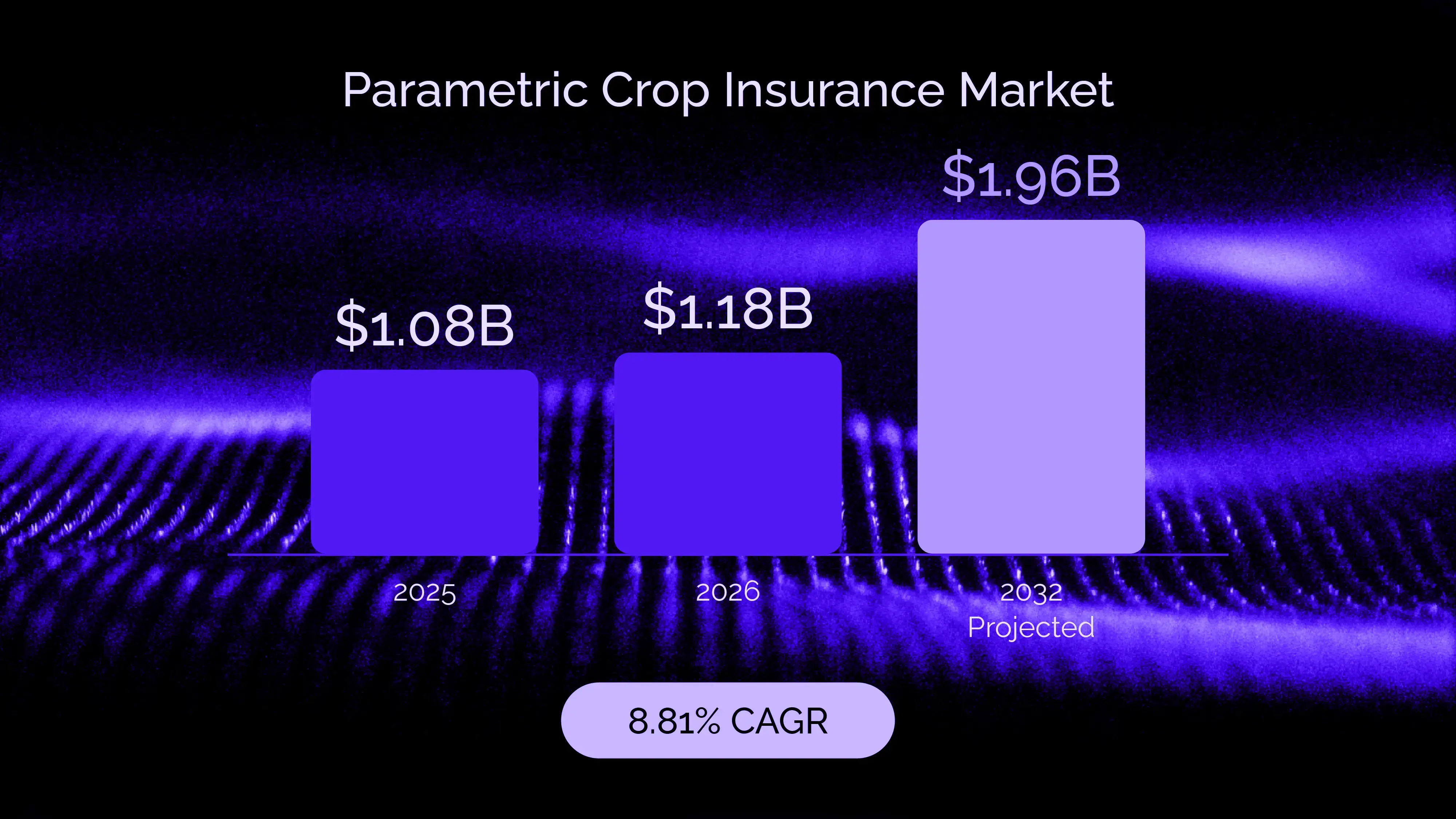
The parametric crop insurance market grew from $1.08 billion in 2025 to $1.18 billion in 2026. It is projected to reach $1.96 billion by 2032 at an 8.81 percent compound annual growth rate, according to Research and Markets.
The broader parametric insurance market is growing just as fast, projected to climb from $4.02 billion in 2026 to $7.64 billion by 2031, a 13.69 percent compound annual growth rate, driven by rising climate-related losses and demand for faster payouts.
Who's actually buying parametric coverage right now?
This isn't a niche product bought only by smallholder farmers in developing markets anymore. Large agribusinesses, agricultural lenders, and public-sector programs are all transitioning toward scalable, data-driven index insurance in response to climate risk and market volatility, according to Research and Markets.
That buyer mix matters architecturally: a lender bundling parametric coverage into a loan product needs different API access and reporting than a public-sector program covering an entire region.
What "purpose-built" means at the backend level
None of this shows up as a single feature you can point to. It's the sum of decisions covered in the rest of this article: an ingestion layer built for real-time index data instead of batch claims, a scoring model your engineering team can actually maintain, and an audit trail that treats every trigger as something a reinsurer will eventually ask about.
Skipping any one of those doesn't make the platform slightly less parametric; it makes the payout promise unreliable in exactly the way that erodes farmer trust fastest.
Solving the AI Gap in Parametric Risk Scoring
Most crop insurance startups need a working risk scoring model months before they can justify hiring an in-house ML team. Parametric insurance projects routinely stall right there, waiting on a model nobody's been staffed to build.
Why do most crop insurance startups not have an in-house ML team?
Scoring models for crop risk lean on well-understood statistical methods, regression against historical yield and weather data, and more than novel deep learning. That changes the hiring problem into an architecture and data-pipeline problem, which a backend engineering team can solve without a dedicated research scientist on staff.
What data do you actually need before you can train a scoring model?
A workable first model needs less than most teams assume: historical yield data by region, the corresponding weather index values for those same seasons, and a record of what actually paid out under any prior coverage.
CHIRPS and NASA POWER, the same data sources feeding the live pipeline, also cover the historical window a training set needs, so there's no separate data-sourcing problem to solve for training versus production. The gap most teams hit isn't data volume; it's getting yield records and index data cleanly joined by region and season before the model ever sees them.
Architecting a scoring model your engineering team can own and explain
The model doesn't need to be a black box to be effective, and it shouldn't be one your team can't maintain after launch. This is the kind of gap we help close directly, pairing a working risk scoring model with engineers who can explain and maintain it, through AI-native development work.
Deploying and retraining without a dedicated MLOps team
A regression-based scoring model doesn't need a full MLOps platform to run reliably, but it does need someone watching for drift as a new growing season's data comes in.
Azure Machine Learning's model registry handles versioning cleanly enough that a small backend team can retrain against a new season, compare performance against the prior version, and promote or roll back without custom tooling.
The retraining cadence matters more than the tooling choice: a model trained once at launch and never revisited will drift away from the crop conditions and index correlations it was built on, usually within a season or two.
Fixing Sync Data: Real-Time Integration with Weather Indices, Satellite Data, and Insurer APIs
Index values, satellite feeds, and insurer systems drift out of alignment with each other more easily than most teams expect. In a lending platform, that kind of sync gap is a reporting problem. In a parametric insurance platform, it's the difference between a trigger firing on time or not firing at all.
Why do parametric triggers fail when data sync lags?
Basis risk and trigger mismatch remain the leading barriers to broader parametric insurance adoption, and spatial differences between insured locations and the data sources measuring them are a direct cause. A pipeline that syncs on a batch schedule instead of validating data freshness in real time makes that mismatch worse.
Building an index data pipeline around real, named data sources
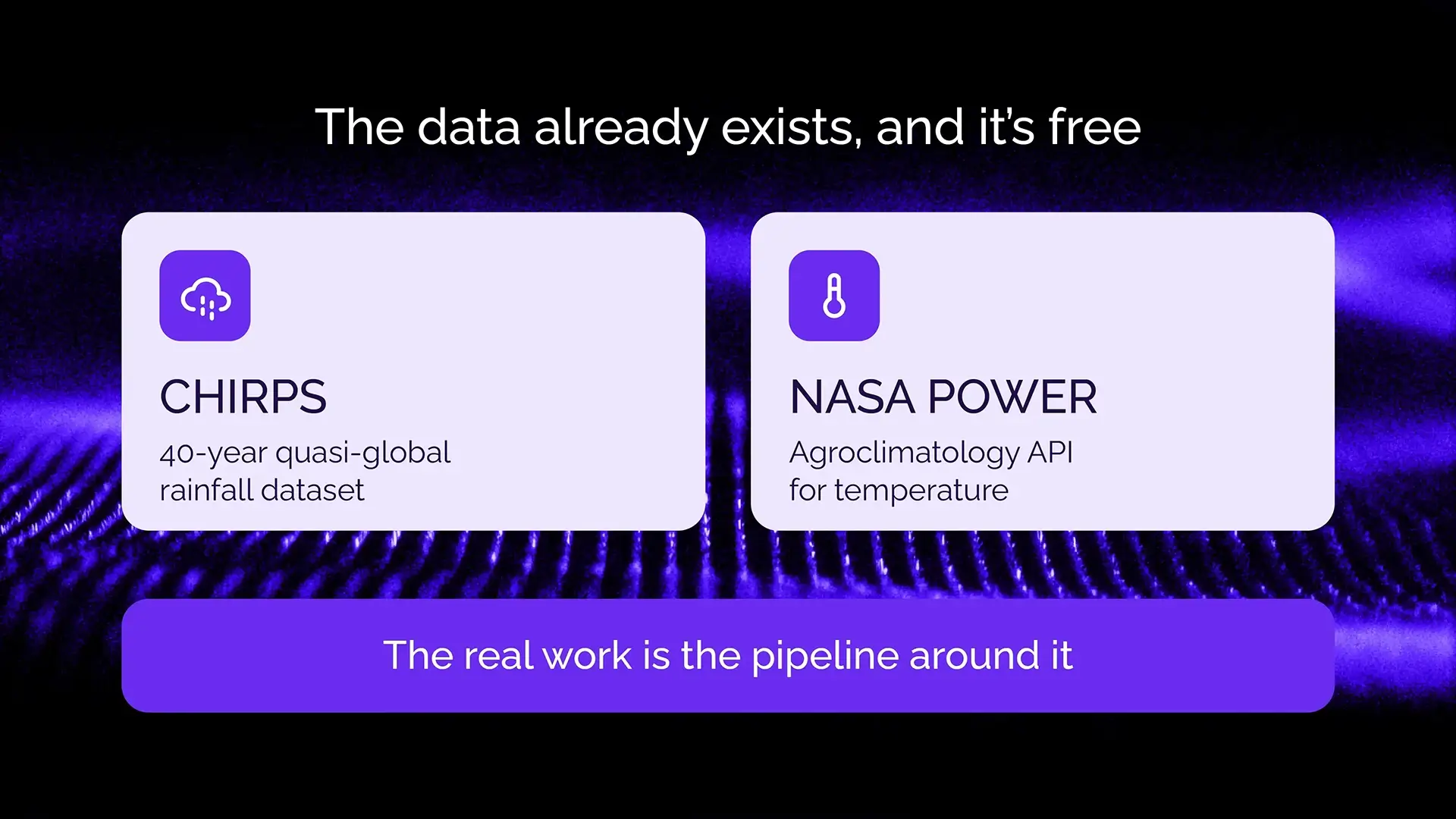
Two data sources cover most of what a parametric crop product needs, and both are real and freely available. CHIRPS is a 40-year, quasi-global rainfall dataset that blends satellite imagery with in-situ station data. NASA POWER provides an agroclimatology API for temperature and related variables.
Raw satellite data needs to be calibrated, georeferenced, cloud-masked, and adjusted for crop phenology before it's usable as a scoring input, and that transformation step is where most of the pipeline engineering work actually lives.
API Design for Insurer and Reinsurer Partners
A reinsurer needs to verify that a trigger fired correctly without re-running your entire pipeline themselves.
What partner APIs need to expose
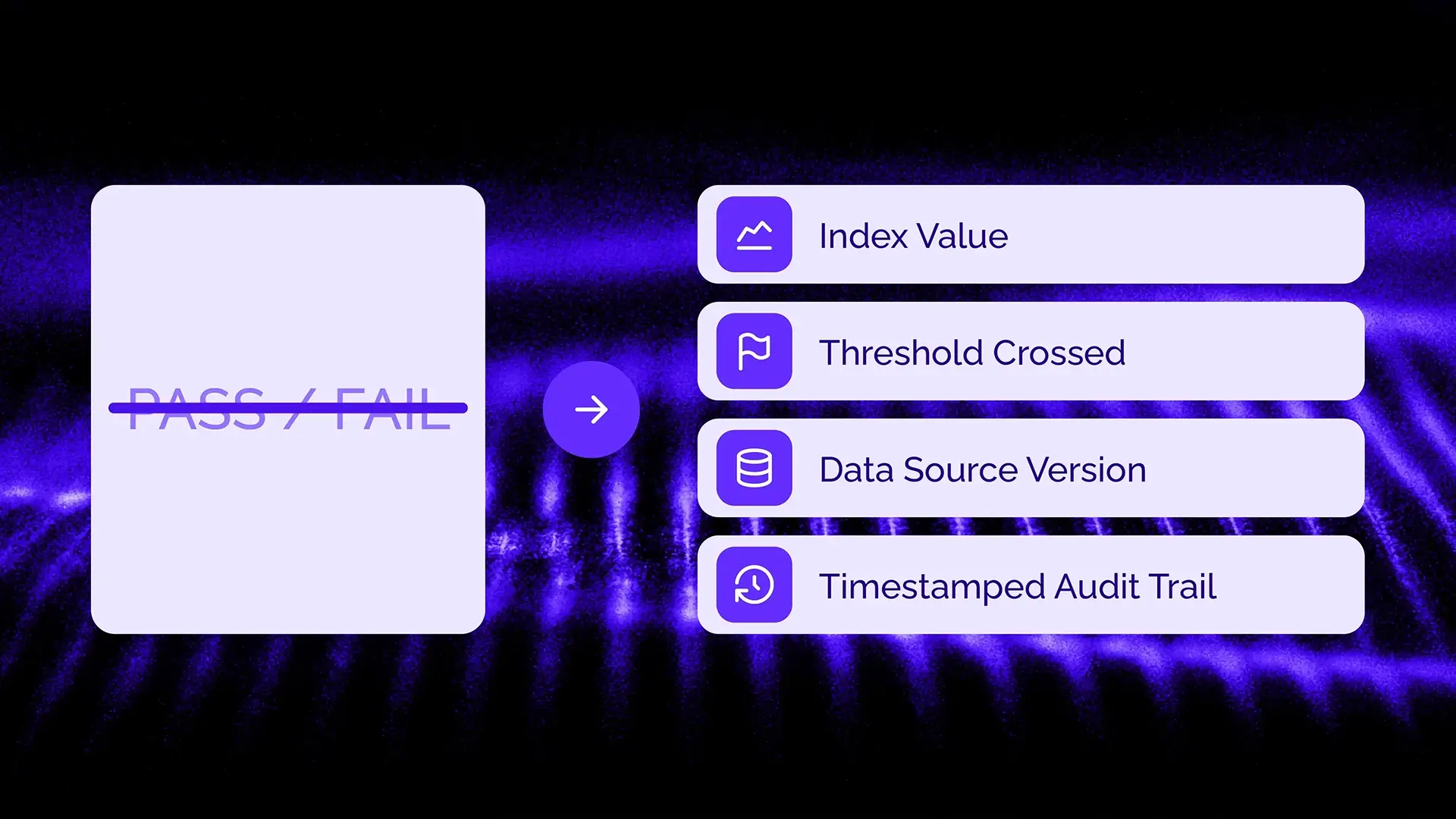
Trigger status alone isn't enough, so partner APIs need to expose the exact index values that caused a payout, the threshold that was crossed, and a timestamped audit trail, not just a pass or fail flag. A reinsurer pricing a book of parametric contracts needs to see the underlying data, not just trust your conclusion.
Authentication and partner-specific access scopes
Insurers and reinsurers aren't interchangeable API consumers, and the access model shouldn't treat them that way. OAuth2 client credentials with partner-specific scopes let a reinsurer pull aggregate trigger data across a whole book of contracts, while an individual insurer only sees the policies they actually underwrite.
Azure API Management handles this cleanly: each partner gets its own subscription key tied to a defined scope, so a scope misconfiguration shows up in a policy review instead of a data leak.
Idempotency and event-driven design for payout events
A payout event should publish once and be consumed by insurer, reinsurer, and farmer-facing systems as subscribers, the same decoupling pattern that keeps any high-volume backend reliable.
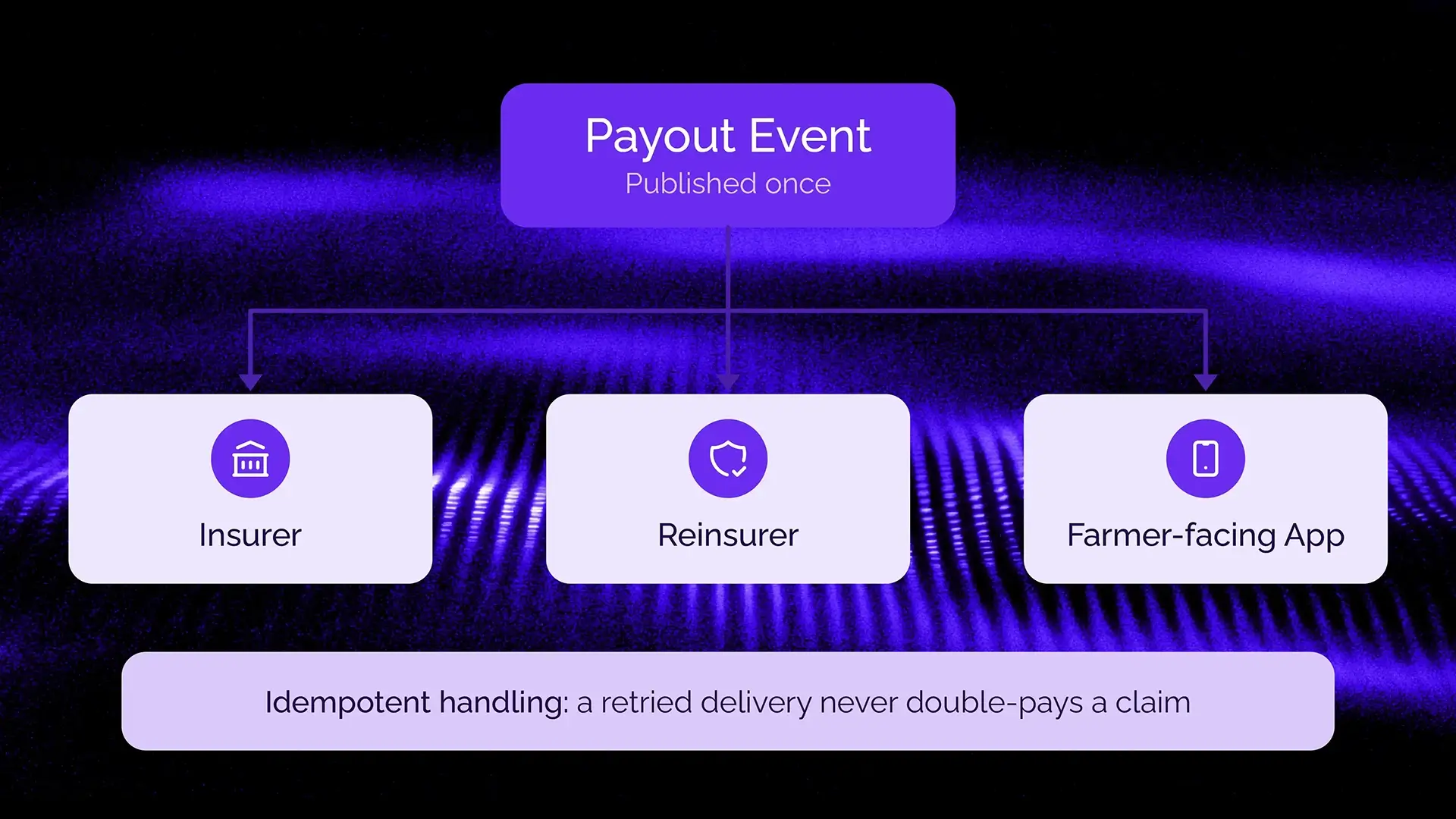
Idempotent handling on every subscriber matters here specifically, because a retried delivery after a network hiccup shouldn't double-pay a claim. Azure Service Bus sessions work well for this: each policy gets its own session, so event ordering per policy stays guaranteed even under retry.
Versioning and webhook design for long-lived integrations
Insurance partnerships run for years, not sprints, so the API has to support versioning from the first integration rather than treating it as a future problem. Semantic versioning on the API surface, plus a deprecation window measured in months rather than weeks, keeps a reinsurer's own integration team from having to scramble every time your scoring logic changes.
Webhooks for payout events should carry a schema version in the payload itself, so a partner's consumer can branch on it instead of breaking silently when a field gets added.
Data Architecture and Audit Trail for Parametric Triggers
Every trigger decision needs to stay defensible months after the payout happened, long after the moment it fired.
Storing index data, thresholds, and trigger events for auditability
An immutable event log, capturing the index value, the threshold, and the data source version at the moment of the decision, is the pattern that holds up here. It's the same audit-container approach that works for financial-grade lending systems, applied to weather and satellite data instead of loan transactions.
Azure Cosmos DB's append-only change feed is a natural fit, since it gives you an immutable record without building custom write-once logic yourself.
Designing for explainability when a regulator or reinsurer asks
Every trigger decision needs its inputs, its threshold, and the exact version of the data source preserved alongside the final outcome. A yes-or-no payout flag with no supporting record won't survive a reinsurer's audit.
Attaching a correlation ID to every stage of the pipeline, from raw satellite ingestion through the final trigger decision, means you can reconstruct the full chain for a single policy in one query instead of piecing it together from separate logs.
Versioning data source changes without breaking historical triggers
CHIRPS, NASA POWER, and satellite providers all update their own data periodically, sometimes retroactively revising a historical value after further calibration. A trigger evaluated against last season's data has to stay evaluated against that exact version, even after the upstream source changes it.
Storing a snapshot of the specific data version used at evaluation time, rather than a live reference to the source, is what keeps a year-old trigger decision defensible after the underlying dataset has moved on.
Retention and access control for audit records
Audit records need a retention policy that outlives the policy term itself, since a claims dispute or regulatory inquiry can surface years after a payout. Role-based access through Microsoft Entra keeps the distinction clean between who can view a trigger's audit trail and who can only see the payout outcome, which matters more here than it might look at first: raw satellite and weather data licensing terms sometimes restrict redistribution, even internally.
Table-level encryption at rest, standard for Cosmos DB and Azure SQL, covers the baseline; the access-control layer is what actually enforces who gets to see what.
Final Thoughts
The architecture in this article gets a parametric crop insurance platform to a trustworthy first product. Here's where we think the underlying data and integration requirements are headed next.
Hybrid, multi-index triggers will become the default
Rainfall, temperature, and satellite-derived vegetation indices are increasingly combined into hybrid triggers tailored to specific crop phenology rather than shipped as single-index products. We expect single-index triggers to look outdated within a couple of product cycles, as basis risk pushes the market toward combined indices.
Satellite data latency will keep shrinking as more sensor constellations come online
Sensor tradeoffs in resolution, revisit time, and latency are improving as more Earth observation constellations reach operational status, narrowing the gap between an observed weather event and a validated trigger. Platforms built on a rigid, single-source pipeline today will need to re-architect for multi-source ingestion sooner than most teams expect.
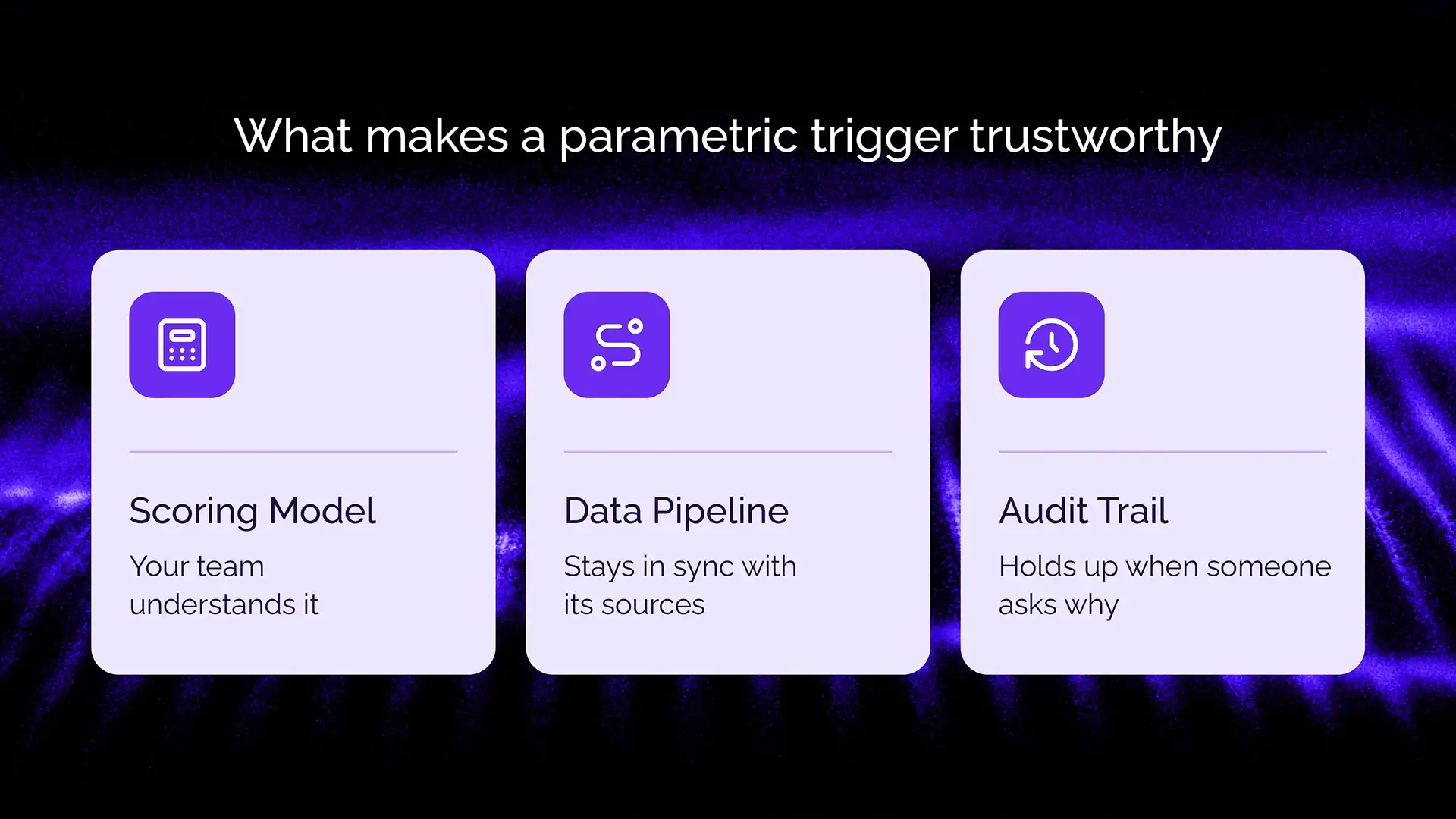
A trustworthy parametric trigger comes down to the same three things every time: a scoring model your team understands, a data pipeline that stays in sync with the sources it depends on, and an audit trail that holds up when someone asks why a payout fired.
Ready to build your risk scoring pipeline?
Scoping a parametric crop insurance platform, or stuck on the model your team can't maintain alone? We'd love to hear about it. Tell us about your data sources and timeline, and we'll help you find the right architecture.
Talk to our team →FAQs
-
What is parametric crop insurance, and how is it different from traditional crop insurance?
Traditional crop insurance pays out based on a manually assessed loss after a claim is filed. Parametric crop insurance pays out automatically once a predefined index, such as rainfall or a vegetation index, crosses an agreed threshold, without a manual damage assessment.
-
What data sources are used to trigger parametric crop insurance payouts?
Rainfall datasets like CHIRPS, temperature data from sources like NASA POWER, and satellite-derived vegetation indices are the most common inputs. Most products combine two or more of these into a hybrid index to reduce basis risk.
-
Do you need an in-house machine learning team to build a crop insurance risk scoring model?
Not necessarily. Crop risk scoring relies more on statistical regression against historical yield and weather data than on novel deep learning, so a backend engineering team can often build and maintain a working model without a dedicated research scientist.
-
How do you reduce basis risk in a parametric insurance product?
Combining multiple index types, such as rainfall and satellite-derived vegetation data, into a hybrid trigger reduces the spatial mismatch between what the index measures and what a farmer actually experiences.
Keeping the underlying data pipeline auditable also makes it possible to identify and correct systematic mismatches over time, rather than discovering them only after a wave of disputed claims.