
AI coding tools have made implementation cheap. GitHub Copilot, for instance, completes code on roughly 46% of keystrokes. Claude Code and Cursor can scaffold an entire feature in minutes. For a lot of teams, the slow part now is everything before the code and not writing code itself.
Researchers at Yan et al. put the rate of vulnerable code generated by LLMs at between 9.8% and 42.1% across benchmarks. A SonarQube analysis of five leading models found that over 70% of Java vulnerabilities generated by Llama 3.2 90 B were rated BLOCKER severity. These are the predictable outputs of a workflow that treats the spec as optional.
Specification-Driven Development (SDD) is the answer to that problem. It doesn't slow AI down and gives AI the context it needs to produce code that actually holds up.
So, our guide covers how to actually implement SDD. We try to answer the questions: what a good spec looks like, how the workflow runs, which tools support it, what goes wrong, and how to roll it out without stalling your team.
Key Takeaways
- SDD treats the specification, not the code, as the primary artifact.
- A spec is not a PRD; it must define external behavior: inputs, outputs, preconditions, postconditions.
- Human review of specs (not just code) reduces LLM-generated code errors by up to 50%.
- LLMs generate vulnerable code at rates of 9.8-42.1% without validation gates.
- ROI typically emerges at 3-6 months; expect a learning curve before gains compound.
What Is Specification-Driven Development?
Specification-driven development is a methodology where a formal specification (not a prompt, not a ticket, not a PRD) is the starting point for every piece of code your team ships.
A spec in SDD is an executable contract written before a single line of code exists. It defines what the software must do: the inputs it accepts, the outputs it produces, the conditions that must hold true before it runs, and the criteria that determine whether it worked. The AI coding agent works from that contract, and validation gates check the output against it.
What does "spec declares intent, code realizes it" mean in practice?
The spec answers what the system must do. The code answers how. Keeping those two questions separate is what gives SDD its leverage.
When you collapse them, when the spec starts describing variables, loops, and implementation details, you've lost the abstraction. You're writing code twice. A good spec defines behavior at the boundary: what goes in, what comes out, and what must be true. Everything inside that boundary is the AI's job.
Not sure where to start with SDD at your organization? We’ll be happy to help!
Get in touchHow is SDD different from Vibe coding and the waterfall model?
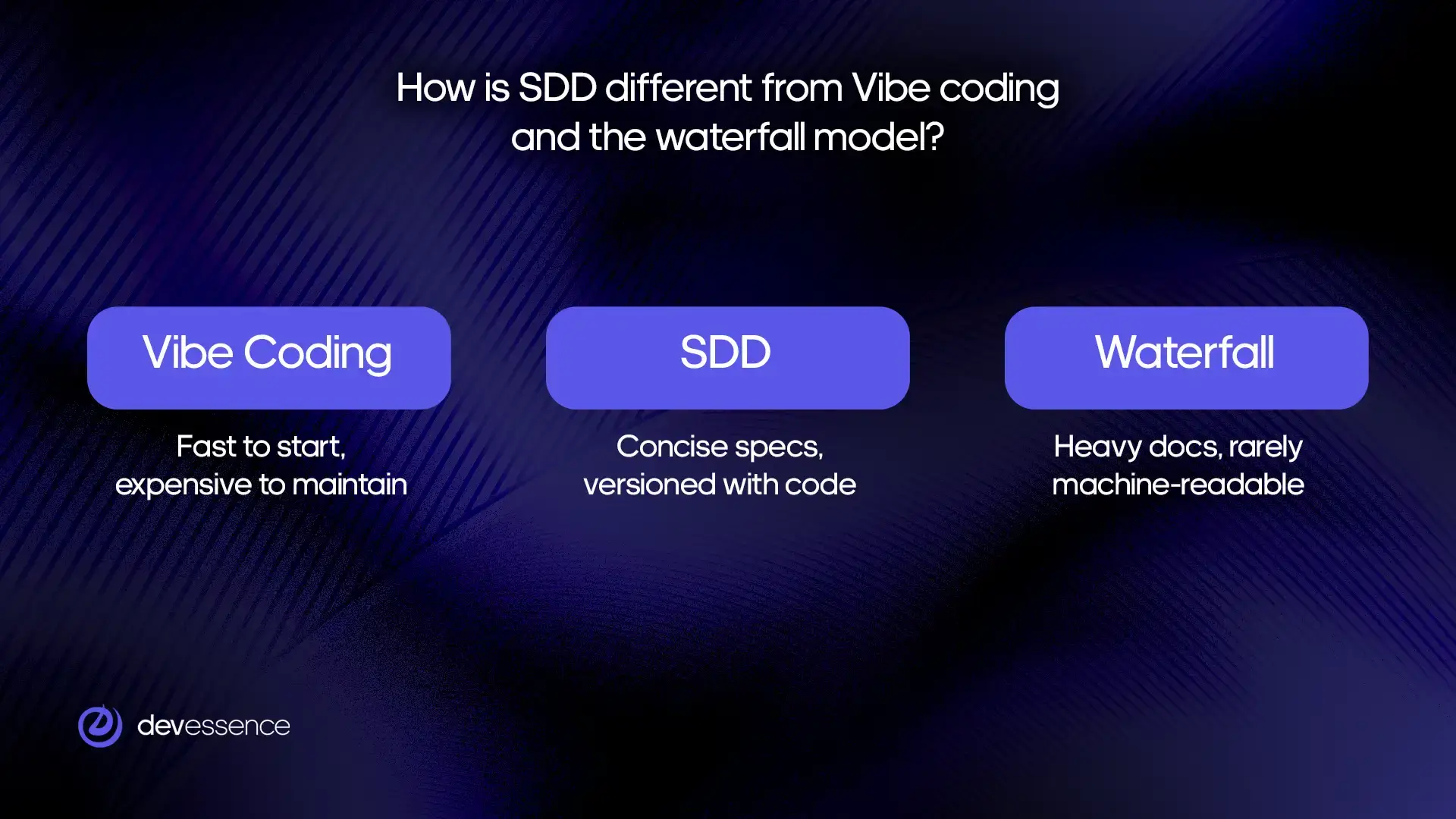
Vibe coding skips the contract entirely. You describe intent loosely, accept whatever the AI generates, and fix problems as they appear. It's fast to start and expensive to maintain.
Waterfall writes extensive documentation upfront, too, but that documentation is rarely machine-readable, rarely kept current, and rarely tied directly to what gets built. It adds process without adding precision.
SDD sits between the two. Specs are concise, structured, and live in version control alongside the code they govern. They're the input that makes AI output reliable.
Read also: AI in Software Development 2026: SDLC Impact, Real Productivity Data & What's Next
What Does a Good Spec Actually Look Like?
From our experience, most teams that struggle with SDD fail at the spec: it's either too vague to reliably guide generation or so detailed it might as well be code.
What goes into a spec?
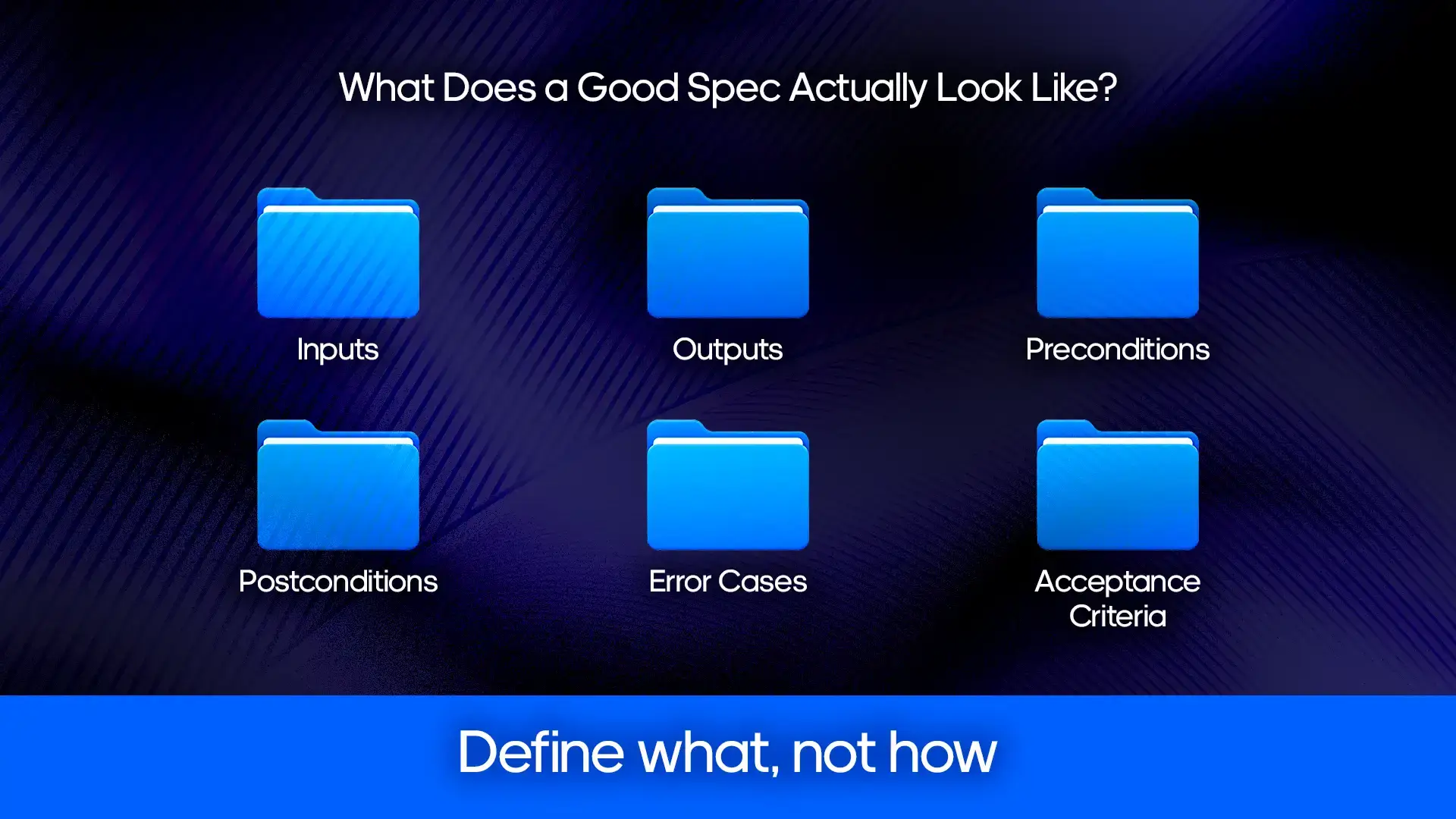
A spec defines the external behavior of a component. Not the implementation, but the contract.
Six elements belong in every spec: the valid inputs, the expected outputs, the preconditions that must hold before it runs, the postconditions that must hold after, the defined error cases, and the acceptance criteria that confirm it worked.
Everything else (variable names, internal logic, library choices) belongs to the implementation.
What does over-specification look like?
Over-specification is when the spec starts answering how instead of what. It names specific functions or classes, describes internal operations rather than observable outcomes, or can only be implemented in one valid way.
A simple test: could this spec be satisfied by more than one implementation? If not, it's too detailed, and now you have a maintenance burden because the spec and the code both need updating every time something changes.
How Does the SDD Workflow Run in Practice?
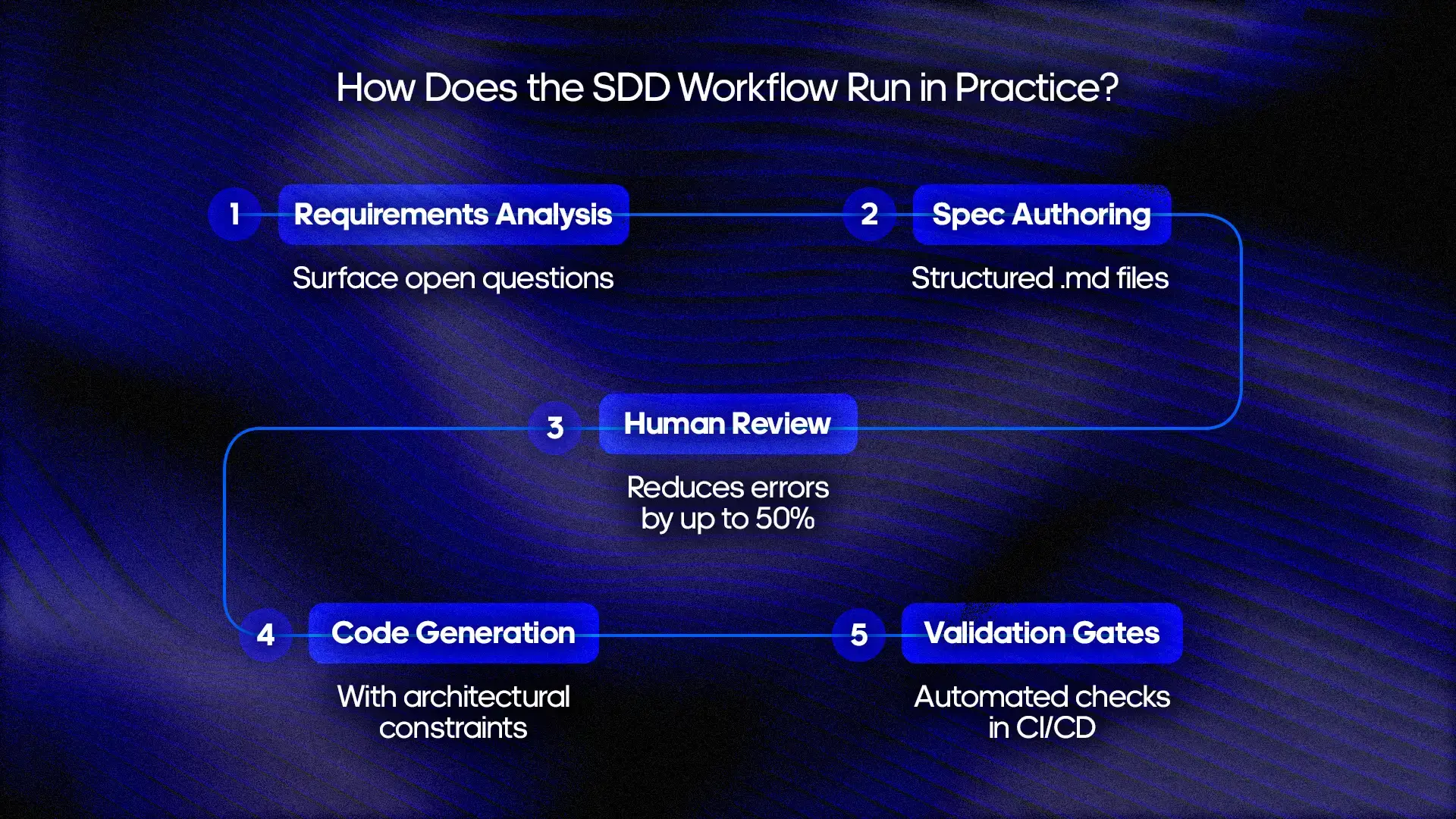
SDD has five phases. Each one has a clear owner and a clear output. The phases are sequential, so skipping or compressing any of them is where most implementations go wrong.
Phase 1: Requirements analysis with an AI agent
Start with your business requirements, like a ticket, a brief, or a stakeholder conversation. Feed them to an AI coding agent and ask it to identify ambiguities, missing constraints, and edge cases before anything gets written.
The output isn't a spec yet, but a list of open questions your team needs to answer. This step surfaces the decisions that would otherwise get made implicitly, mid-generation, when they're much harder to reverse.
Phase 2: Spec authoring in structured .md files
With the open questions resolved, write the spec. Use a structured markdown file: inputs, outputs, preconditions, postconditions, error cases, acceptance criteria. Keep it in version control from day one. The spec is a primary artifact, so it should be tracked, reviewed, and versioned like code.
Phase 3: Human review
This is the step most teams are tempted to skip. Don't.
AI-generated code frequently passes unit tests while violating architectural patterns or introducing security vulnerabilities that only surface in production. Human review of the spec before generation begins is what prevents that. Research shows it reduces LLM code errors by up to 50%.
Review for two things: vagueness that will produce unpredictable output and over-specification that removes the AI's ability to make sound implementation decisions.
Phase 4: Code generation with architectural constraints
Hand the validated spec to your coding agent along with explicit architectural constraints. They are defined in Cursor rules, an AGENTS.md file, or your platform's equivalent. These constraints set the boundaries the generated code must stay within: patterns to follow, dependencies to use, anti-patterns to avoid.
Don't treat the first generation as final. Run it, review the output against the spec, and iterate. The spec is the benchmark: if the code satisfies it, you're done.
Phase 5: Validation gates in CI/CD
The spec becomes an active validation layer in your pipeline. These are automated checks that confirm the code still satisfies its contract before anything merges to production.
Security scans, test execution, contract checks: all of these run against the spec. When the spec changes, the gates update with it. The slow divergence between what the spec says and what the code does protects against spec drift.
We consult engineering teams at every stage of AI adoption: from setting up your first spec workflow to enterprise-scale implementation.
Contact us to get startedWhich Tools Support SDD?
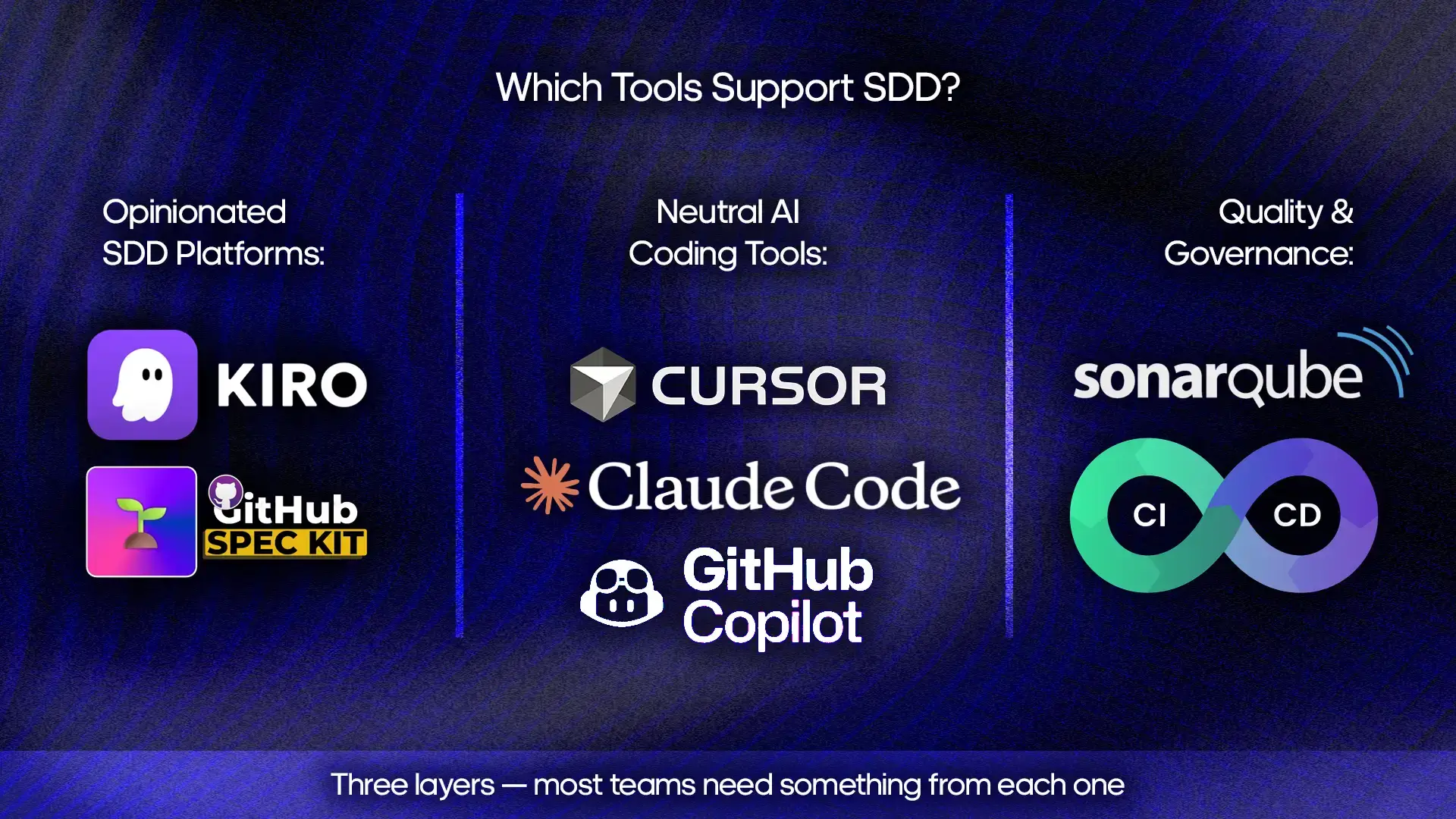
The SDD tool landscape expanded significantly in 2024-25, with 15+ platforms launching support for spec-driven workflows. They fall into three layers, and most teams need something from each one.
Opinionated SDD platforms
These tools treat SDD as a first-class workflow, not an optional convention.
Amazon Kiro is the most structured option available. Requirements analysis, spec authoring, and code generation are built-in steps – the workflow is enforced by the platform, not agreed on by the team. AWS used it internally to reduce a two-week notification feature to two days. Best for teams that want guardrails and low setup overhead.
GitHub Spec Kit (launched September 2024) formalizes SDD within the GitHub ecosystem. It's one of the most structured implementations available and integrates naturally with existing GitHub workflows. Best for teams already standardized on GitHub who want SDD without adopting a new platform.
Neutral AI coding tools
These tools support SDD but don't enforce it. The workflow is yours to define.
Cursor works well with SDD via Cursor rules and AGENTS.md files. Flexible and widely adopted, but consistency depends on team discipline.
Claude Code handles complex, multi-file generation and integrates cleanly with spec files. No predefined SDD structure, so it is best suited to teams with a mature spec practice who want agentic capability on top of it.
GitHub Copilot is the lowest-friction entry point. A reasonable starting tool for teams piloting SDD before committing to a dedicated platform.
Quality and governance layer
This layer is non-negotiable regardless of which tools you use above it.
SonarQube catches security vulnerabilities in AI-generated code before they reach production. Given that LLMs generate vulnerable code at rates of up to 42.1% across benchmarks, static analysis is the safety net under the whole workflow.
Deterministic CI/CD compensates for LLM non-determinism. Even with a well-formed spec, AI output varies across runs. A highly deterministic pipeline that includes consistent environments, pinned dependencies, spec-driven validation gates keeps that variability from reaching production.
How do you choose?
Two questions narrow it down quickly.
How mature is your spec practice? If your team is new to writing formal specifications, start with an opinionated platform. Kiro or GitHub Spec Kit will enforce the right habits before they become optional. If you already have a structured spec workflow, neutral tools give you more flexibility without the constraints.
How large is your team? Smaller teams benefit from opinionated platforms. They get less overhead, faster adoption, and fewer conventions to agree on. Larger teams with established engineering culture often prefer neutral tools they can integrate into existing workflows. Enterprise teams should factor in governance requirements: which tools support audit trails, access controls, and compliance documentation.
Whatever you choose at the top two layers, invest in the governance layer first. The quality of your CI/CD and static analysis determines whether SDD actually holds as the AI coding tool is just what generates the input.
Read also: AI-Assisted Software Development: Pros, Cons, Processes
What Are the Most Common SDD Mistakes?
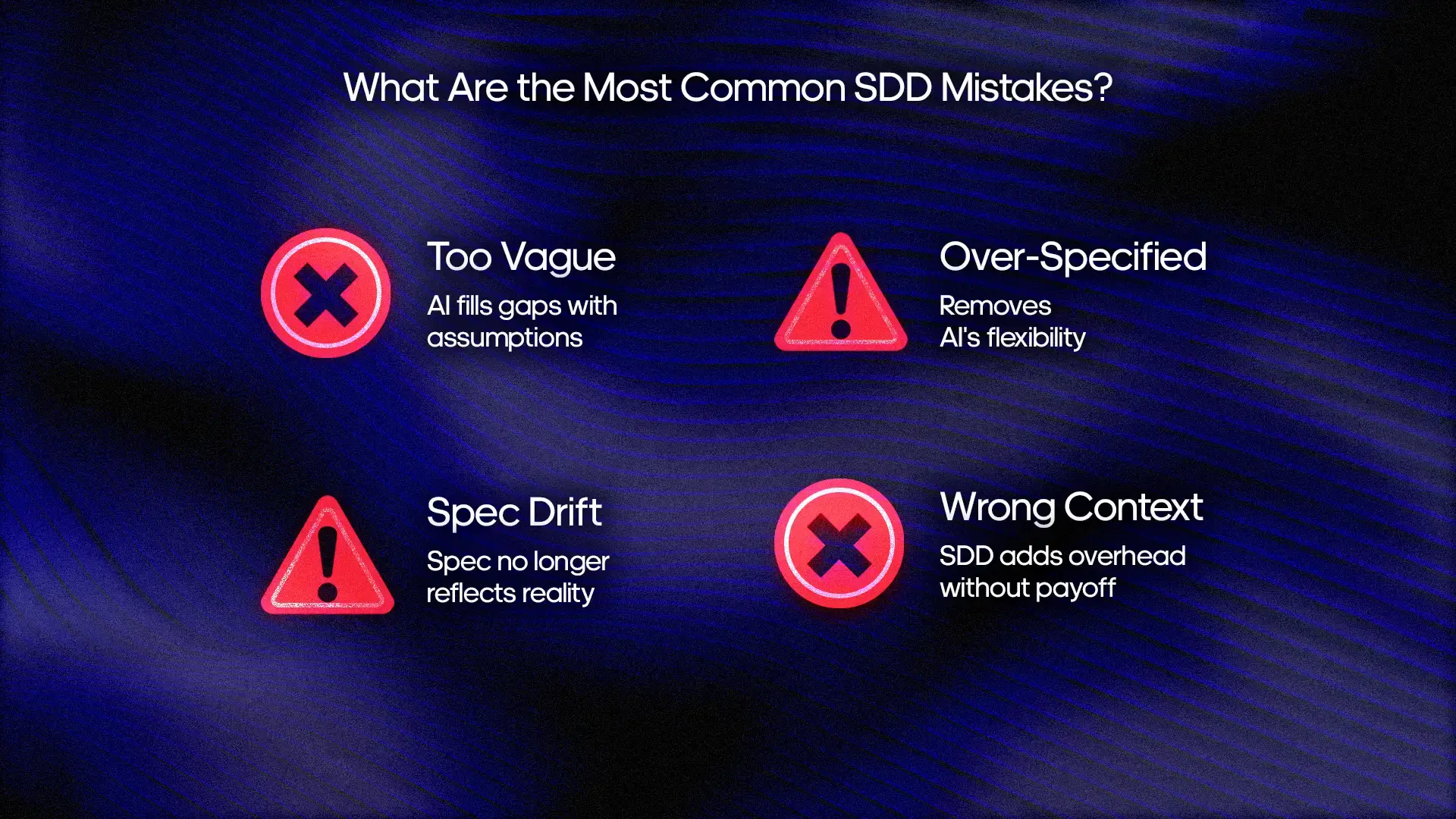
Spec quality determines whether SDD delivers or disappoints. The same patterns show up across teams at every maturity level.
What happens when specs are too vague?
When a spec leaves meaningful decisions open, the AI fills those gaps with assumptions. Sometimes they hold. Often, they don't, and the problem only surfaces in production.
Every ambiguity in a spec is a decision delegated to the AI. Resolve the right decisions before generation begins.
What does over-specification actually cost you?
A spec that names specific functions, describes internal operations, or can only be satisfied one way removes the AI's ability to make sound implementation decisions. The output suffers, and so does maintainability. Every implementation change now requires updating two things instead of one.
How does spec drift happen, and how do you prevent it?
Spec drift starts with small, undocumented changes and compounds until the spec no longer reflects what the system does. The new generation runs from an inaccurate source, and validation gates check against stale requirements.
Two controls prevent it: make spec updates part of your definition of done, and run spec-versus-code consistency checks in CI/CD.
When does SDD make things worse?
SDD adds structure. In the wrong contexts, that structure is overhead without payoff.
It struggles with prototyping and research spikes, where the problem space isn't yet understood. It struggles with rapidly changing requirements, where the spec can't stay current. And it struggles with exploratory UI work, where design decisions are too iterative to formalize upfront.
Apply SDD where correctness, security, and maintainability matter. Use something lighter everywhere else.
How Do You Measure Whether SDD Is Working?
Without a baseline, it's impossible to tell whether SDD is improving delivery or just adding process. Measure before you adopt, then check again at 60 and 120 days.
What metrics matter in an SDD workflow?
Cycle time by phase. How much time does work spend on development, review, and testing separately? SDD typically compresses development time while review time rises initially. Tracking phases individually shows where bottlenecks are moving; a flat overall cycle time can hide meaningful shifts underneath.
Defect rate. How many bugs reach production per release cycle? This is the most direct indicator of whether spec quality is holding. A rising defect rate after SDD adoption means code volume is outpacing review discipline, or specs aren't resolving the right ambiguities.
Review throughput. How much reviewed and merged code is the team producing relative to what's waiting in the queue? AI increases code volume. If review capacity doesn't scale with it, throughput stays flat regardless of how fast generation runs.
Spec reuse rate. How often are existing specs referenced or adapted rather than written from scratch? Rising reuse is a signal that your spec library is maturing and that the team is building on prior work rather than reinventing it.
What does good look like at 3 months vs. 6 months?
At three months, the signal to look for is stability. Defect rates should be holding steady or falling. Cycle time in development should be shorter. Review throughput may still be adjusting; that's normal.
At six months, the compounding effects should be visible. Spec reuse rises as the library grows. Review throughput improves as the team calibrates how much AI output to accept versus rework. Delivery frequency, how often the team ships, should be measurably higher than the pre-adoption baseline.
If delivery frequency hasn't moved by month six, the productivity gains are staying inside the development process and not reaching users. That's the metric that matters at the business level.
Read also: How to Build a Sustainable AI Productivity Strategy
Final Thoughts
Specification-driven development is a disciplined response to a real problem. AI has made code generation fast and cheap. What it hasn't made easier is knowing what to build, defining it precisely, and ensuring the output is correct. That's still a human job.
The core idea is simple: the specification is the primary artifact. Code is what the specification produces. Before any generation begins, you define external behavior, including inputs, outputs, preconditions, postconditions, and acceptance criteria. The AI coding agent works from that specification. Validation gates check the output against it. The spec lives in version control alongside the code it governs.
AWS reduced a two-week feature to two days. Airbnb migrated 3,500 test files in six weeks against an estimated timeline of 1.5 years. Empirical research shows that human-refined specifications reduce LLM code errors by up to 50%.
The teams seeing the strongest results from SDD are the ones that invested in spec quality first: clear contracts, consistent review, and validation gates that catch drift before it reaches production. Expect three to six months before the gains compound. But for production systems where correctness and maintainability matter, the structure SDD adds pays back more than it costs.
We work with engineering teams at every stage of AI adoption. If you're ready to move beyond ad-hoc AI generation and build a workflow that scales, let's discuss your needs.
Contact usFAQs
-
Is SDD compatible with Agile?
Yes. SDD doesn't change how work is planned or prioritized, but changes what happens before generation begins. Specs fit naturally into existing Agile ceremonies: writing and reviewing a spec is a definition-of-ready step, not a separate process. Teams typically scope specs at the story or task level, keeping them lightweight enough to complete within a sprint without disrupting cadence.
-
Does SDD replace the need for experienced developers?
No. SDD shifts where experienced developers focus, not whether they're needed. Writing a precise spec that resolves the right ambiguities without over-constraining the implementation requires a deep understanding of the system, its constraints, and its failure modes. So does reviewing AI-generated output against that spec. The work changes; the judgment required doesn't.
-
How does SDD change code review?
The focus of the review shifts upstream. With SDD, the most important review happens at the spec level, before any code is generated. By the time the code exists, the key decisions have already been validated. This makes code review faster and more targeted. Reviewers are checking implementation quality against a defined contract rather than reiterating requirements mid-PR.
-
Can SDD work on legacy codebases?
Yes, with caveats. Legacy codebases often lack the clean boundaries and documented behavior that make spec authoring straightforward. Undocumented dependencies, inconsistent patterns, and accumulated technical debt all increase the cost of writing accurate specs. The practical approach is to apply SDD incrementally: new features and significant refactors first, using the spec authoring process itself to surface and document behavior that was previously implicit.