Plenty of precision agriculture platforms start as a single-tenant build because that's the fastest way to get three pilot customers through a harvest season and prove the product works. The trouble usually shows up about eighteen months later. Customer twelve needs a new SQL Server instance provisioned by hand.
Customer thirty wants to know why onboarding takes two weeks. And the engineer who should be building the yield-prediction model your sales team already promised is instead patching database number nine.
Field monitoring and yield analytics products often reach this point at the same time: a single-tenant architecture that can't scale into a real multi-tenant SaaS business and can't absorb AI features because nothing in the stack was built to serve a model.
In our new article, we'll break down how to design a precision agriculture SaaS architecture on .NET and Blazor that handles both problems together: multi-tenant from the data layer up and built to serve AI features rather than bolt them on later.
Key Takeaways
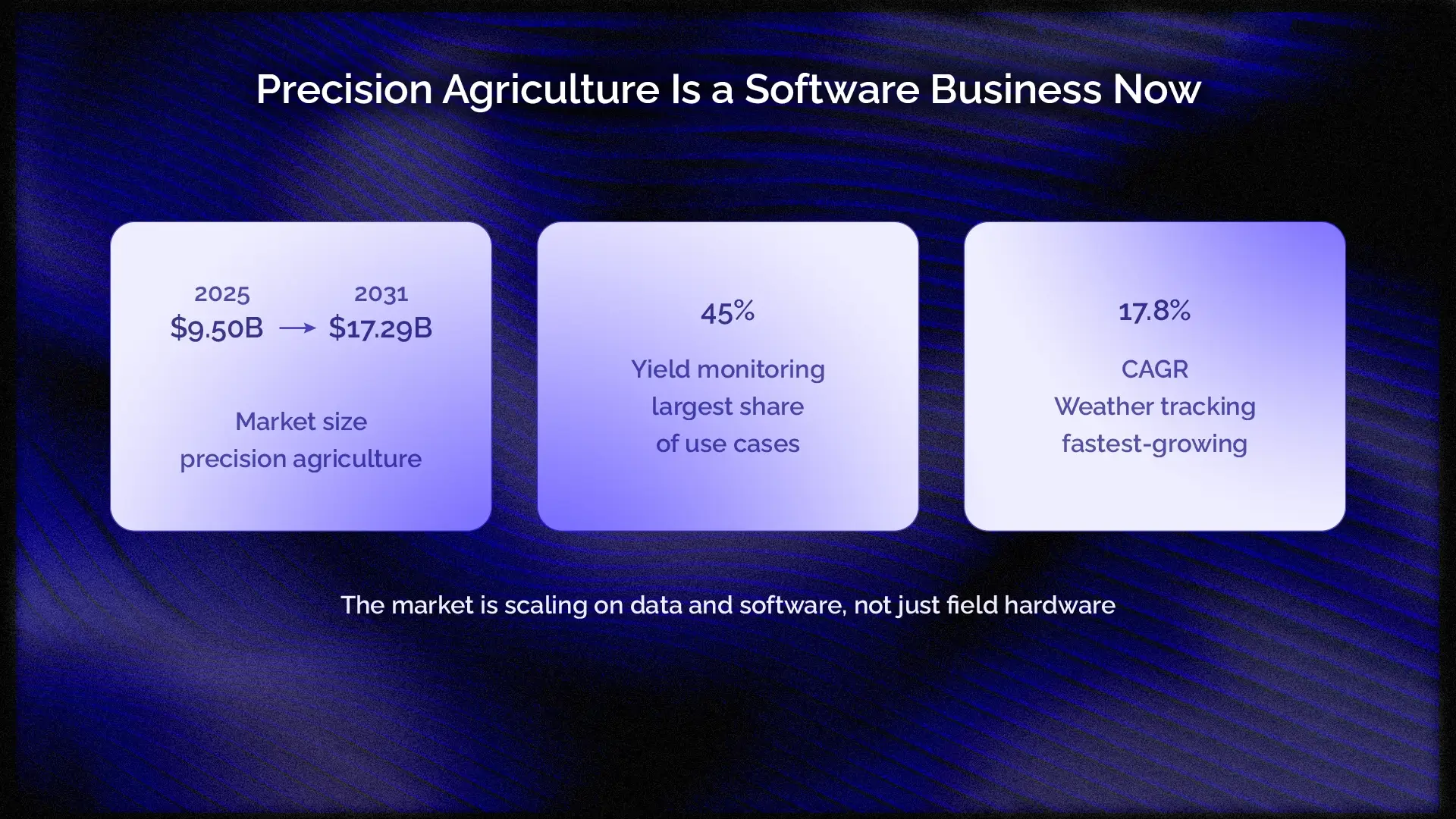
- Precision agriculture is a software business now; the global precision agriculture market is projected to grow from $9.50 billion in 2025 to $17.29 billion by 2031, and AI-enabled agronomy is named a direct driver of that growth.
- Manual, single-tenant provisioning is "process debt." Every new customer that requires a human to spin up infrastructure is a hidden tax on your growth rate, not a one-time cost.
- The tenancy model you choose (silo, pool, or bridge) has to be decided per architectural layer, not once for the whole platform: sensor ingestion, tenant databases, and AI/ML workloads often warrant different models.
- Yield monitoring already holds the largest share of precision farming software use cases (45% in 2025), which means yield analytics is the workload your architecture has to scale for first, not an afterthought.
- Weather tracking and forecasting is the fastest-growing application segment (17.8% CAGR), which signals real-time data ingestion and freshness as a core requirement.
- Blazor and ASP.NET Core give agtech teams a single C# codebase across web dashboards, tenant-aware APIs, and background ingestion services, which matters when your platform team is small, and your field-data volume is not.
- Retrofitting AI into a single-tenant platform is a rewrite. Designing the tenant and data layer to support model serving from the start is a feature.
Why Precision Agriculture SaaS Platforms Outgrow Single-Tenant Architecture
At the pilot stage, a single-tenant setup is a reasonable choice. Each customer gets their own database and their own deployment, so isolation is trivial, one customer's bug can't touch another's data, and there's no need for a tenant-aware identity model when there's only ever one tenant in the environment.
The problems start once the customer count climbs. Onboarding time scales with headcount, because someone has to provision a new environment by hand each time. Releases scale the same way, since a fix has to go out to every instance separately instead of once. And field data makes this worse than it would be for most SaaS businesses: a single mid-size farm can produce a continuous stream of soil, weather, and equipment telemetry, and running dozens of siloed customer environments turns "add a server" into "manage N separate ingestion pipelines."
Call it process debt. It's not that anything was built wrong: the operating model that worked fine at three customers actively fights you at thirty.
What Is Process Debt Actually Costing You?
Engineering time is the easiest way to describe this problem, but it isn't the way a CTO ends up justifying the fix to a board or a budget line. Translated into cost, the picture gets sharper.
A rough cost-of-delay calculation
A simple way to size this: engineer-hours per manual provisioning cycle, multiplied by new tenants per quarter, multiplied by a fully loaded engineering rate. That number is your quarterly cost of staying single-tenant, and unlike a one-time expense, it grows every quarter your customer count grows.
What this looks like at 40 customers
Take a hypothetical 40-customer field-monitoring platform provisioning new tenants by hand at roughly 3 engineer-days per customer, around 24 hours. At a fully loaded senior .NET engineer cost of $85 an hour, that's about $2,040 per new tenant before any features get built. Add 10 new customers in a quarter and manual onboarding alone runs upward of $20,000 in engineering time, on top of the same engineers not being available for anything else that quarter.
The AI Gap is delayed revenue, not just a missing feature
A yield-prediction feature that sales already promised and can't ship isn't a backlog item sitting quietly; it's revenue that was counted on and isn't landing, and in some cases a renewal risk if a customer bought expecting AI capability that never arrives. Framed that way, the AI Gap has a dollar figure attached to it too, not just an engineering timeline.
What Does a Multi-Tenant Architecture Actually Look Like on .NET and Blazor?
The AWS Well-Architected SaaS Lens, the industry-standard reference for this problem, frames multi-tenancy as a set of choices made per component rather than a single decision for the whole system: sensor ingestion, tenant databases, and AI workloads can each land on a different model.
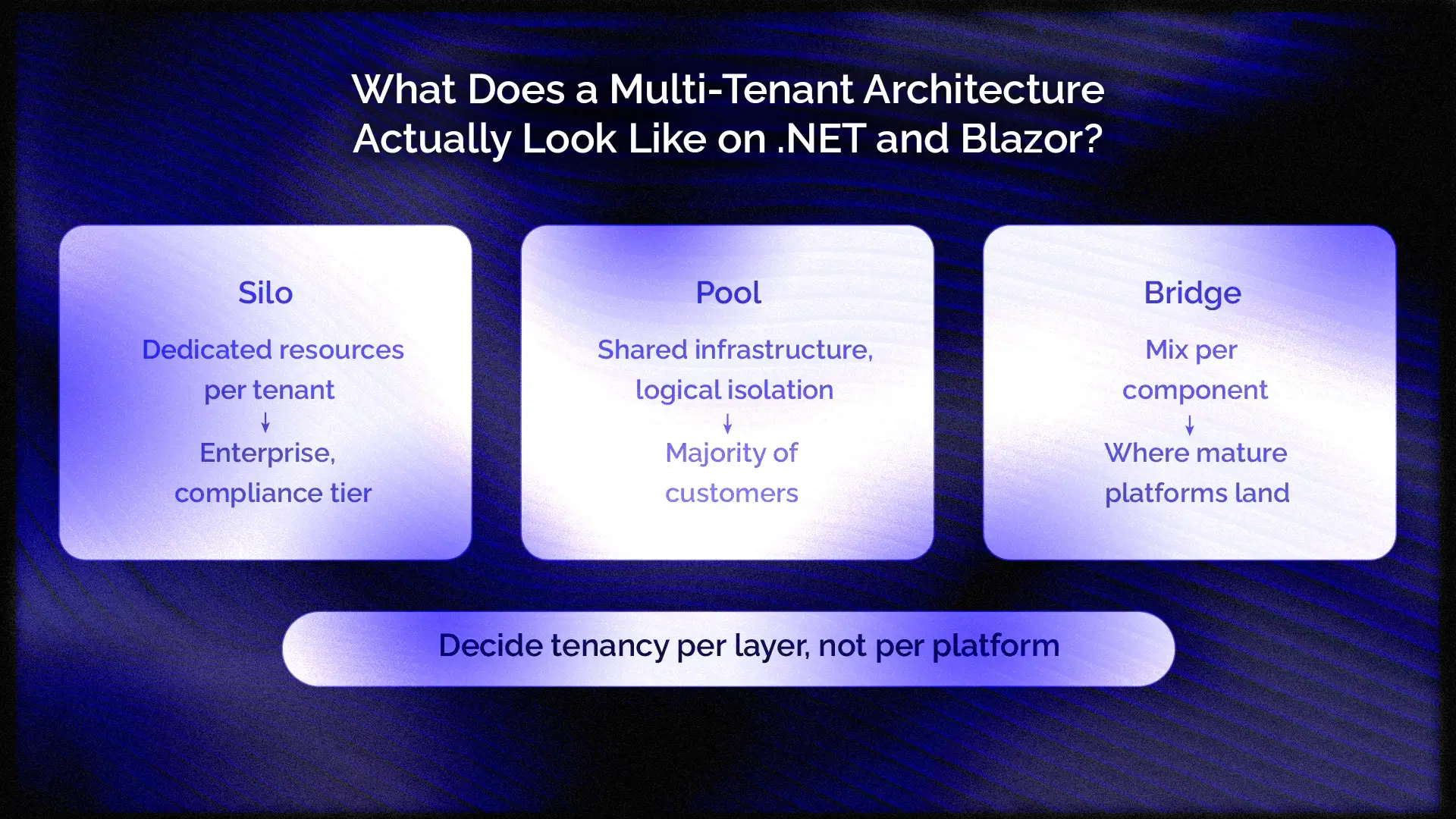
The three tenancy models and where each one fits a precision ag platform:
Model |
How it works |
Where it fits a field-monitoring/yield platform |
Silo |
Each tenant gets dedicated resources (own database, own compute) |
Large enterprise ag operations with compliance or data-residency requirements; your highest-tier customers |
Pool |
All tenants share the same application instance and infrastructure, isolated logically |
Small-to-mid farm operations onboarding through self-serve or sales-led flows; the majority of your customer base |
Bridge |
A mix – some components siloed, some pooled, per component |
Most mature platforms land here: pooled web/API layer, siloed database for enterprise tier, shared AI inference layer |
On a .NET and Blazor stack, this tends to break down across three areas.
Tenant identity and context should be resolved once, early in the pipeline
Give your ASP.NET Core authentication and authorization middleware the job of resolving tenant context alongside user identity on the first request, rather than scattering WHERE TenantId = ? clauses through query code later. Propagate that context through claims or a scoped service so every downstream call – including background jobs processing sensor data – picks it up automatically.
Database strategy should default to pooled, not siloed
For the pool tier, a shared database with row-level tenant isolation (EF Core global query filters) turns provisioning a new tenant into a matter of minutes instead of days, so it's the right default. Save dedicated per-tenant databases – the silo model – for enterprise customers who actually need them for compliance, not as your default onboarding path.
The Blazor front end can stay a single shared codebase across tenants
Blazor Server and Blazor WebAssembly both support one UI codebase that renders differently per tenant, including branding, feature flags, farm-specific dashboards, without a separate front-end deployment for each. A lot of legacy platforms' two-week onboarding problem comes down to exactly this: a new customer means a forked UI build, and it doesn't have to.
How Do You Design for Field Data at Scale?
Precision ag platforms live or die on ingestion. Soil sensors, weather stations, drone imagery, GPS-guided equipment, and yield monitors all produce continuous streams that need somewhere reliable, fast, and tenant-aware to land.
A shared, horizontally scalable ingestion pipeline built on something like Azure Event Hubs or a message-queue pattern in front of your ASP.NET Core services handles bursty, unpredictable sensor load across every tenant far more efficiently than running one pipeline per customer.
Two areas matter most, and both line up with where the market itself is growing fastest.
Real-time weather and telemetry freshness matters more than historical reporting
The weather tracking and forecasting application segment is growing at a 17.8% CAGR, faster than any other precision farming application category, which tells you customers increasingly want live conditions rather than end-of-day batch reports. Your ingestion layer needs a real-time or near-real-time path, not just a nightly ETL job.
Yield data deserves its own domain, not a shared sensor table
Yield monitoring already holds the largest share of precision farming software use, at 45% of the market. Treat yield data as a first-class domain from the start because bolting it onto a generic "sensor reading" table now just means re-architecting that table within a year, and it's the workload your customers are actually paying for.
Your ingestion pipeline is starting to strain under tenant growth? We help agtech platform teams redesign for scale without a full rewrite
Contact us →Where Does AI Actually Fit Into a Multi-Tenant Ag Platform?
The second half of this problem is structural. A single-tenant, per-customer architecture forces you to deploy, monitor, and retrain a model, or a model-serving endpoint, separately for every customer environment, which turns an AI roadmap into an ops burden fast.
A multi-tenant, AI-native architecture handles this by treating model inference as its own shared service, the same way you'd treat authentication or logging.
Shared inference can respect tenant-scoped data without a copy per customer
A single model-serving layer hosted via Azure Machine Learning, a containerized inference API, or an MCP-based tool integration can serve predictions to every tenant while still respecting tenant data boundaries. The model doesn't need its own copy per customer; it needs correctly scoped access to each tenant's data at inference time.
Yield prediction and anomaly detection become platform features, not custom builds
Once your data model treats yield and sensor data consistently across tenants, a single predictive model trained on aggregate, anonymized patterns across your customer base can serve yield forecasts or flag anomalous readings for everyone, without a bespoke integration per account.
A clean tenant model leaves room to grow into agentic workflows
Platforms with a clean tenant-context and shared-service model already in place are better positioned to add agent-driven features later: automated irrigation recommendations and proactive equipment maintenance alerts as agentic AI tooling matures. Platforms still running siloed, single-tenant environments end up paying for that gap twice, first in missed features now, then again in migration cost later.
What Does a Practical Migration Path Look Like?
None of this requires rebuilding everything at once. A workable sequence for teams migrating from single-tenant to multi-tenant looks like this.
Introduce tenant context before touching the database
Add tenant resolution to your ASP.NET Core middleware and propagate it through claims, so every new feature you build from here on is tenant-aware by default, even while the database underneath is still single-tenant.
Migrate new customers to the pooled model first
Leave existing single-tenant customers running as they are for now. New business goes on the pooled model right away, which stops manual provisioning from growing any further without forcing a risky migration of your whole customer base at once.
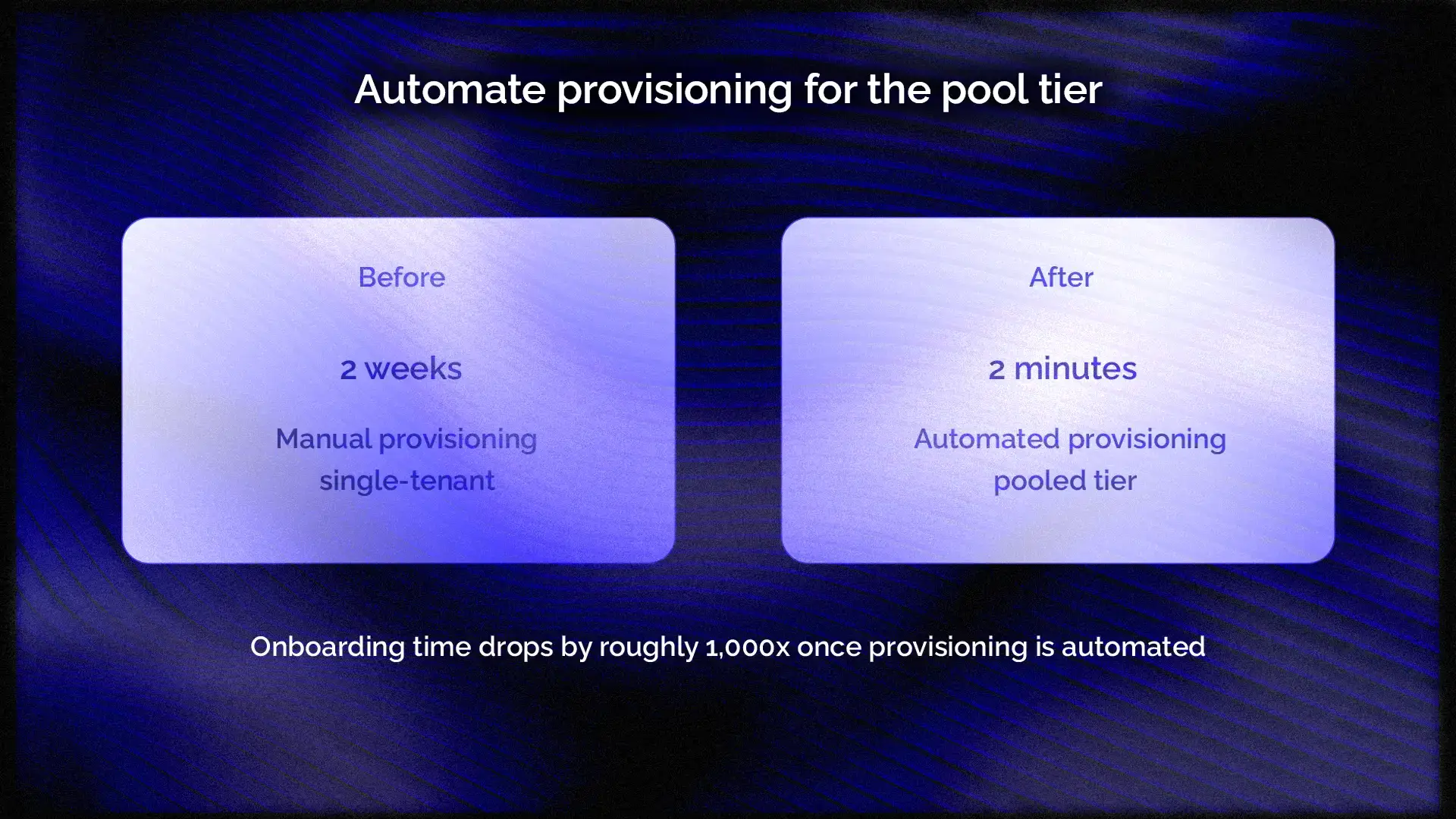
Automate provisioning for the pool tier
This is usually the single highest-leverage investment in the whole process, and it's what turns a two-week onboarding process into a two-minute one.
Build the shared AI/ML service layer against the pooled tenant model
The pooled tier already has consistent tenant context end to end, which makes it the cleanest place to prove out tenant-scoped inference before extending it to legacy customers.
Migrate remaining single-tenant customers opportunistically
A renewal, a support incident, or a feature request the old architecture can't support are all natural points to fold a customer into the migration, rather than setting a fixed cutover date for everyone.
Should You Build This In-House or Bring in a Partner?
Once the migration path is clear, the next decision is who executes it. Most agtech platform teams weigh three options, and the right one depends less on budget than on what the team can afford to stop doing for a few months.
Rebuilding in-house
Your own engineers know the product and the domain, and there's no ramp-up cost. The tradeoff is opportunity cost: the senior engineers capable of doing a multi-tenant migration correctly are usually the same ones your roadmap depends on, and a first-time migration carries real risk of costly mistakes in tenant isolation or data modeling that surface only after customers are live on it.
Hiring contractors for the migration
Contractors can add capacity quickly without pulling core engineers off feature work. The tradeoff is that generalist contractors often haven't done a multi-tenant .NET and Blazor migration before either, so the learning curve just moves to a different team, and the tenant-model expertise leaves with them when the contract ends.
Partnering with a specialized team
A partner who has already made the silo, pool, and bridge decisions on similar platforms brings that judgment in from day one instead of relearning it on your codebase. For a small agtech engineering team, this usually means your own engineers stay focused on the agronomy features that actually differentiate the product, while the partner handles the tenancy and AI-serving-layer plumbing underneath it.
Final Thoughts
Most agtech teams stuck in this position didn't build the wrong product. The architecture that got them to their first ten customers is now working against them at their next hundred, and that gap is exactly why AI features that should take weeks end up taking quarters, if they ship at all.
Tenant-aware AI inference is likely to become the default within two years
Gartner projects that 40% of enterprise applications will ship with integrated, task-specific AI agents by the end of 2026, up from under 5% in 2025 – one of the fastest adoption curves it tracks across any enterprise technology category.
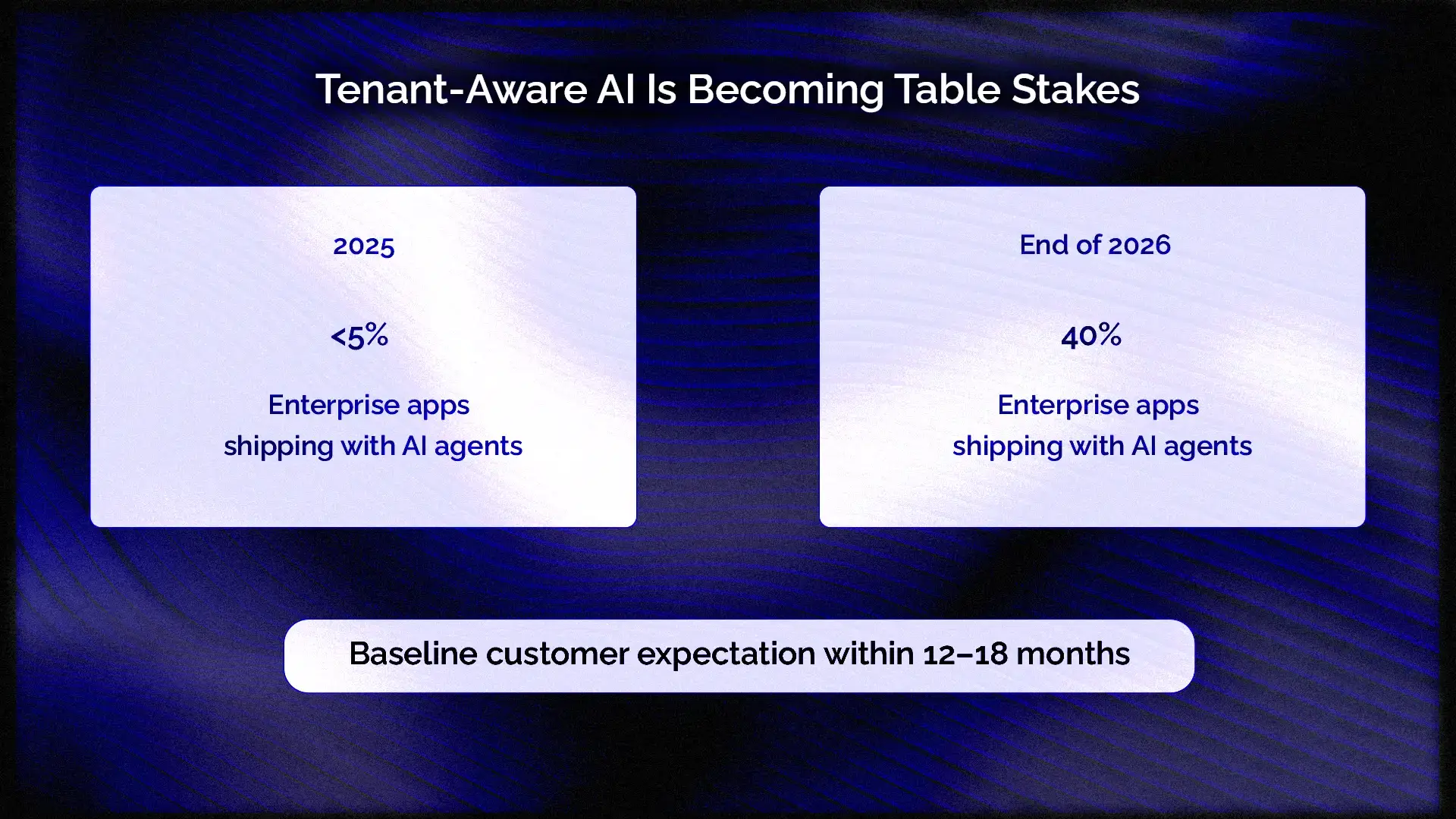
Precision agriculture platforms won't be exempt from that shift. The ones that move fastest will be the ones where adding a new predictive model or agentic workflow is a configuration change against an existing shared inference layer, not a new architecture project.
Expect tenant-aware, shared AI inference to become a baseline customer expectation for agtech SaaS platforms within the next 12 to 18 months, roughly the same window it took multi-tenant provisioning itself to go from differentiator to table stakes in horizontal SaaS a few years back.
The gap between early movers and laggards will show up in shipping speed, not just cost
As AI-enabled agronomy continues driving the precision agriculture market from $9.50 billion in 2025 toward a projected $17.29 billion by 2031, most platforms will eventually have some version of a yield-prediction feature.
The real competition will be over who can ship the next one, and the one after that, without a multi-quarter architecture project standing in the way each time. Platforms that migrated to a multi-tenant, AI-native architecture early will show that advantage in release velocity long before it ever shows up in a sales number.
There's a capital dimension to this too. As the precision agriculture market grows toward $17.29 billion, it's also attracting more funding and more entrants, which means slower-shipping incumbents aren't just competing against their own roadmap anymore. The cost of a slow architecture isn't only the engineering hours it burns; it's the ground it quietly gives up to competitors who can ship the next AI-driven feature first.
If your platform is still spinning up infrastructure by hand for every new customer, or your team keeps putting off AI features because the architecture can't support them cleanly, it's worth talking through before that migration gets any harder.
We help agtech platform teams design and migrate multi-tenant, AI-native architecture on .NET and Blazor
Let’s talk →FAQs
-
What is a multi-tenant SaaS architecture?
A multi-tenant SaaS architecture is a system where a single application instance and shared infrastructure serve multiple customers ("tenants"), with each tenant's data kept isolated through logical controls like row-level security rather than separate physical infrastructure per customer.
-
Is Blazor a good fit for a precision agriculture platform?
Yes. Blazor lets teams build tenant-aware dashboards, farm-specific views, and admin tooling in a single C# codebase shared with the backend, which keeps the maintenance load manageable for small agtech engineering teams supporting a growing customer base.
-
How do you add AI features to an existing single-tenant ag platform without a full rewrite?
Start by introducing tenant context into the request pipeline, then build a shared, tenant-scoped inference layer for new customers on a pooled model. Extend AI features to legacy single-tenant customers opportunistically rather than migrating everything at once.
-
What's the difference between silo, pool, and bridge tenancy models?
Silo gives each tenant fully dedicated resources. Pool has all tenants sharing the same infrastructure with logical data isolation. Bridge mixes the two, applied per component, and it's where most mature SaaS platforms end up: pooling most of the system and siloing only what compliance or enterprise contracts actually require.
-
Why is yield data the priority for a precision agriculture data model?
Yield monitoring already accounts for the largest share of precision farming software use, at 45% of the market in 2025. That's the workload most customers are actively paying for, so treating it as a well-modeled, first-class domain from the start avoids a costly rework of the data model later.