Multi-Tenant Architecture in .NET: Building Scalable SaaS with Blazor [video]
1/21/2026
By: Devessence Inc
Building a SaaS application inevitably forces teams to make a foundational architectural choice early on: should each customer run in their own isolated environment, or should multiple customers share the same application and infrastructure?
This decision shapes far more than hosting costs. It influences how the system scales, how upgrades are rolled out, how tenant data is isolated, and how much operational complexity the team will carry long term. In practice, it determines whether a SaaS platform remains efficient and manageable as it grows or slowly becomes fragile and expensive to maintain.
In this article, we explore multi-tenant architecture in .NET as presented in the original talk. It explains what multi-tenancy actually means, why it is commonly used in SaaS systems, where it delivers clear advantages, and where it introduces real constraints. We also walk through the key architectural and technical considerations teams must account for when implementing multi-tenancy with Blazor and modern .NET.
Key takeaways
- Multi-tenant architecture shapes cost, scalability, security boundaries, and long-term operability of SaaS systems.
- Shared infrastructure improves efficiency and scalability, but shifts responsibility for isolation and correctness into application design.
- Dedicated and shared tenancy models represent trade-offs between control and efficiency rather than right or wrong choices.
- In Blazor and modern .NET, multi-tenancy requires explicit handling of tenant resolution, context propagation, and service lifetimes.
- Background processing, external integrations, and deployment amplify multi-tenant risks when tenant context is not handled deliberately.
- Frameworks like Oqtane demonstrate how multi-tenancy can be implemented consistently when architectural decisions are made upfront.
What Does Multi-Tenancy Actually Mean?
Multi-tenancy is an architecture where a single instance of a software application serves multiple clients, also called tenants. This is different from a single-tenant model, where every client gets their own dedicated infrastructure, application instance, and database.
A useful analogy is an apartment building. Each tenant has their own apartment they can configure to some extent, but everyone shares plumbing, electrical systems, and other core infrastructure. Multi-tenant software works the same way: shared foundations, logically separated tenants.
This architectural approach is widely used in SaaS because it allows one system to serve many customers efficiently.
Why Teams Choose Multi-Tenant Architecture
Here are the most common reasons we see in our practice.
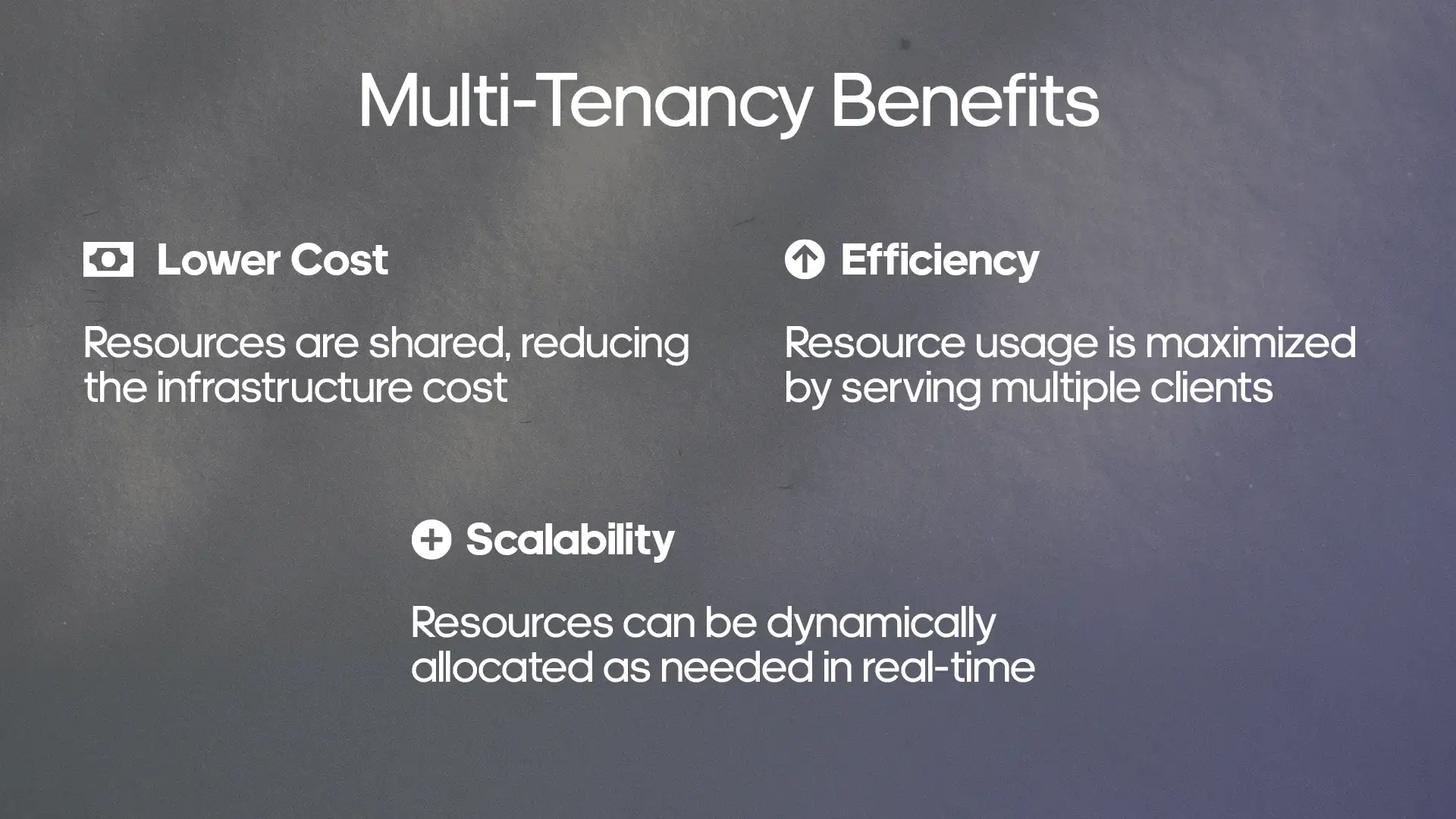
Lower runtime and infrastructure costs
The most common reason teams adopt a multi-tenant architecture is cost reduction. Instead of maintaining separate infrastructure for every customer, a single shared runtime serves multiple tenants. This means fewer servers, fewer databases, and fewer isolated environments to provision and maintain.
From a runtime perspective, this directly reduces operational expenses. Shared infrastructure requires less compute, storage, and networking capacity overall, which lowers hosting and cloud costs, especially at scale. For SaaS products with many customers, this cost difference becomes significant very quickly.
More efficient use of infrastructure resources
Single-tenant systems are often inefficient by nature. Infrastructure is typically sized for peak usage, yet most of the time those resources remain underutilized.
In a multi-tenant system, workloads from different tenants naturally overlap at different times. As a result, CPU, memory, and storage are used more consistently across the system. Instead of sitting idle, resources are shared and consumed as needed by multiple tenants, leading to higher overall utilization and less wasted capacity.
Faster and more flexible scalability
Multi-tenant architecture also provides advantages in how systems scale.
Rather than provisioning new infrastructure for every new customer, tenants can be created or removed dynamically at runtime. This allows new environments to be spun up almost instantly without deploying new application instances or databases in every case.
At the system level, scaling becomes more flexible. The platform can scale up or scale down based on aggregate demand across all tenants, instead of reacting to individual customers in isolation. This makes it easier to respond to growth, seasonal usage patterns, or temporary load spikes without excessive infrastructure overhead.
Planning a SaaS platform? Talk to our team about choosing the right multi-tenant architecture before scaling becomes expensive.
Contact usThe Trade-Offs Teams Must Account For
Multi-tenant architecture offers clear benefits, but it also introduces trade-offs that teams must understand before committing to a shared model. These challenges are not edge cases but structural consequences of sharing runtime, storage, and application logic across multiple tenants. Recognizing them early makes it easier to design a system that remains stable, secure, and maintainable as it grows.
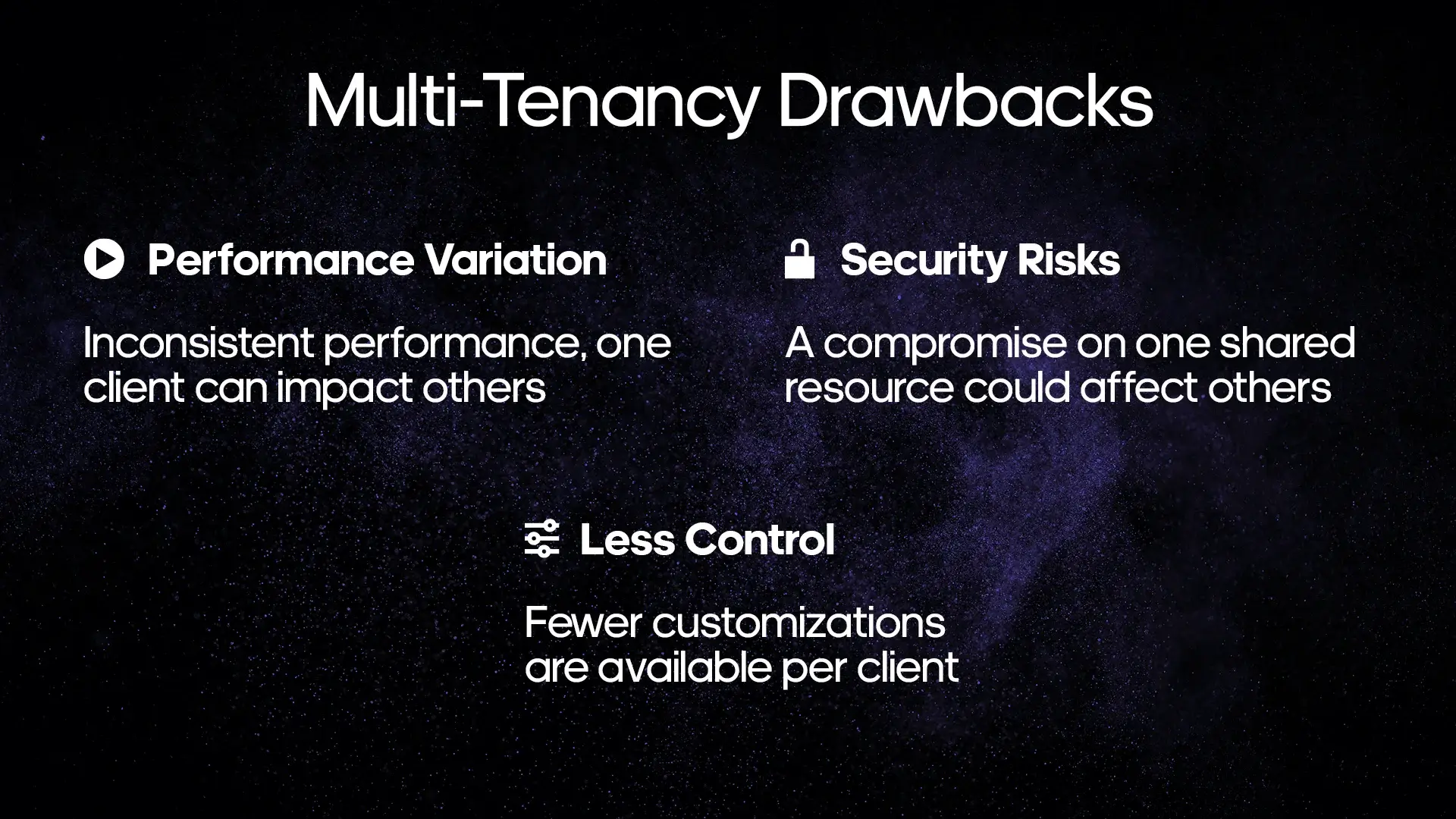
Performance variation in shared environments
One of the primary drawbacks of multi-tenant architecture is performance variation. Because multiple tenants share the same infrastructure, they also share the same pool of resources. If one tenant consumes a disproportionately large amount of CPU, memory, or I/O, it can negatively impact the performance experienced by other tenants.
This behavior is inherent to shared systems. Unlike dedicated environments, where resource usage is isolated, multi-tenant systems require careful design and monitoring to prevent individual tenants from affecting the overall stability and responsiveness of the application.
Increased security risk due to shared resources
Security is another important consideration in multi-tenant systems.
When tenants share runtime infrastructure or storage, isolation must be enforced at the application level rather than guaranteed by physical separation. If a security issue occurs for one tenant – whether due to misconfiguration, a vulnerability, or faulty isolation logic – it can potentially expose other tenants using the same shared resources.
This does not mean multi-tenancy is inherently insecure, but it does mean that security boundaries must be designed deliberately and tested thoroughly. Shared environments reduce the margin for error compared to fully isolated deployments.
Reduced control over tenant-specific customization
Multi-tenant systems are typically designed around a single version of the application that is configured differently for each tenant. This works well when tenants have similar requirements, but it becomes problematic when customer needs diverge significantly.
If tenants require extensive customization, unique workflows, or deeply different configurations, a multi-tenant approach may introduce complexity rather than reducing it. In these cases, forcing all tenants into a shared model can lead to brittle configuration logic and increased maintenance effort.
Limitations in meeting highly specialized requirements
Because multi-tenancy prioritizes shared behavior and centralized management, it is not always well-suited for environments where clients have highly specialized operational or regulatory requirements.
When customers demand strict isolation, unique infrastructure characteristics, or highly tailored behavior, a dedicated model may offer more control and predictability. Multi-tenancy trades this level of control for efficiency, and teams must decide whether that trade-off aligns with their product and customer expectations.
Why Isn’t Multi-Tenancy Tooling Common?
There is a practical industry reason you don’t see strong first-class tooling for multi-tenant application platforms.
Large cloud vendors, such as Microsoft, Google, and Amazon, make money by selling infrastructure. The tools they promote naturally encourage creating more infrastructure: more services, more environments, more resources.
At the same time, these vendors use multi-tenancy heavily inside their own SaaS products. However, the internal tooling they use to build those systems is rarely exposed to developers.
This is a business model. It also explains why many popular architectures (cloud-native systems, microservices, and highly distributed designs) often result in more infrastructure than is strictly necessary.
Choosing Between Dedicated and Shared Models
Architectural decisions around tenancy should always follow business priorities rather than technical preference alone. Dedicated and shared models solve different problems, and each introduces its own set of trade-offs around cost, control, scalability, and operational complexity.
Understanding when each model is appropriate helps avoid over-engineering—or choosing an architecture that becomes restrictive as the product grows.
When dedicated resources are the better fit
Dedicated resources are often the right choice when strong isolation is a primary requirement. This is especially true in environments where tenants must be fully separated at the infrastructure or database level.
Regulatory constraints can also push teams toward dedicated deployments. In some industries, physical separation of data is required by law, making shared storage models impractical or non-compliant.
Dedicated models are also better suited for customers with highly customized needs. When tenants require unique configurations, workflows, or behavior that diverges significantly from others, isolation simplifies development and maintenance.
Another factor is scalability at the individual tenant level. If specific customers experience predictable spikes in usage, dedicated infrastructure allows their environments to be scaled up or down independently without affecting others.
Finally, when time-to-market for a single customer is more important than long-term operational efficiency, dedicated resources can reduce upfront complexity. Teams can focus on delivering functionality for one client without designing for multi-tenant constraints from day one.
When shared resources make more sense
Shared resources are often preferable when cost control is a major business priority. By serving multiple tenants from the same runtime and infrastructure, teams can significantly reduce operational expenses.
This model works best when tenants have similar functional requirements and can be supported by a single configurable version of the application. In these cases, shared systems simplify maintenance and reduce duplication.
Shared environments also enable rapid provisioning. New tenants can be added—or removed—in real time without standing up entirely new infrastructure, which supports faster onboarding and operational flexibility.
From an operational standpoint, shared models simplify upgrades and configuration changes. Updates can be applied once and made available to all tenants simultaneously, rather than being rolled out across multiple isolated environments.
Finally, shared architectures are well-suited to systems designed to scale out at the platform level. Instead of scaling infrastructure per customer, the system scales based on aggregate demand across all tenants.
Accepting the trade-offs
There is no universally correct choice between dedicated and shared models. Each approach reflects a set of trade-offs between isolation and efficiency, control and simplicity, speed and scalability.
The right decision depends on the type of customers being served, the regulatory environment, and the long-term goals of the product. Successful architectures are the ones that align technical design with business reality from the start.
Tenancy Architecture Models Explained
There are several tenancy patterns that sit on a spectrum, from fully isolated systems to fully shared environments. Each model represents a different balance between isolation, cost, and operational efficiency.
Understanding these models helps teams choose an architecture that aligns with both technical constraints and business priorities.
Isolated tenancy (single-tenant model)
In the isolated tenancy model, each tenant runs in a completely independent environment.
Each tenant has:
- its own application instance;
- its own database;
- its own infrastructure.
Nothing is shared between tenants. This model provides the clearest separation and the strongest isolation, which simplifies reasoning about security, performance, and data ownership.
However, this simplicity comes at a cost. Because every tenant requires a full stack of resources, isolated tenancy is the most expensive option and often leads to underutilized infrastructure.
Shared infrastructure with isolated applications
In this model, infrastructure is shared, but application and data boundaries remain separate.
Each tenant has:
- its own application instance;
- its own database.
The underlying infrastructure, such as servers or cloud resources, is shared across tenants, which reduces infrastructure cost compared to fully isolated deployments.
This approach maintains strong isolation at the application and data level while introducing some operational efficiency through shared infrastructure.
Application tenancy with isolated databases
Application tenancy moves further toward sharing.
In this model:
- a single application instance serves all tenants;
- each tenant has its own isolated database.
The application is designed to be tenant-aware and serves different tenants based on context, while data remains physically separated at the database level.
This model balances isolation with operational efficiency. It reduces deployment and maintenance overhead while still keeping tenant data clearly separated, which can be important for compliance or backup strategies.
Fully shared tenancy
In the fully shared model, all tenants share the same environment.
All tenants use:
- one application instance;
- one database;
- one infrastructure environment;
Tenant data is separated logically using tenant identifiers rather than physical boundaries. The application is responsible for ensuring that each tenant only accesses its own data and functionality.
This model offers the lowest operational cost and the highest infrastructure efficiency. At the same time, it requires the most discipline in design, testing, and validation to prevent cross-tenant issues and ensure consistent behavior.
Runtime constraints you must plan for
Regardless of the tenancy model, every system operates within finite runtime limits.
At runtime, applications are constrained by:
- CPU;
- memory;
- caching;
- network I/O.
In a shared environment, these constraints apply collectively across all tenants. Resource usage by one tenant can directly affect others if not carefully managed.
Because of this, responsibility shifts away from the infrastructure and toward the application itself. The application must actively manage how resources are consumed and how tenant workloads are isolated to maintain stability and predictable performance across the system.
Designing with these constraints in mind is essential for any multi-tenant architecture to function reliably at scale.
Storage strategies and their implications
Storage decisions matter just as much as runtime decisions. Here are the four database approaches:
- Isolated server. Each tenant has its own database server. This offers maximum isolation and portability, but at the highest cost.
- Shared server, separate databases. One database server hosts multiple databases, one per tenant. Isolation is preserved at the database level, while infrastructure cost is reduced.
- Shared database, isolated schemas. Tenants share a database but use separate schemas. This requires database support for schemas and careful management.
- Shared database, shared schema. All tenants share a single schema, separated logically by tenant identifiers. This is the most cost-efficient approach, but the hardest to operate safely, especially for backups, restores, and migrations.
Why SaaS and multi-tenancy go together
SaaS applications are typically built to deliver the same core functionality to a broad set of customers through a centrally managed system. This model places a strong emphasis on minimizing operational overhead, keeping upgrades simple, and controlling infrastructure costs.
Multi-tenant architecture aligns naturally with these goals. By sharing runtime and infrastructure across customers, SaaS providers can operate a single system more efficiently, apply updates centrally, and scale the platform without duplicating environments for every tenant.
Unsure whether shared or dedicated tenancy fits your product? Get a free consultation and validate your architecture decisions early.
Contact usMulti-Tenancy in Blazor and Modern .NET
Modern .NET is capable of supporting complex systems, but many of its core abstractions were not designed with multi-tenancy in mind. Dependency injection, identity and authentication, configuration via IOptions, and logging through ILogger all assume a single-tenant context by default.
Because of this, building multi-tenant applications in Blazor and modern .NET requires deliberate architectural decisions and additional customization to ensure tenant boundaries are enforced consistently.
Tenant resolution
Tenant resolution determines which tenant an incoming request belongs to so the application can return the correct data and behavior.
The most common approach is URL-based resolution using domains, subdomains, or path segments. Other strategies include cookies or HTTP headers when clean URLs or shared domains are required. In some cases, the tenant context is inferred from user identity or network information.
Tenant resolution must occur early in the request lifecycle. If it happens too late, the system risks serving incorrect data or applying the wrong configuration.
Tenant context: the core complexity
Once a tenant is identified, its context must flow through the entire system.
This includes UI components, backend APIs, data repositories, and access to static or content assets. The challenge becomes more pronounced when frontend and backend components run in separate processes, where the tenant context cannot be implicitly shared.
Tenant context must be passed explicitly and safely. Failure to do so can lead to cross-tenant data access, incorrect behavior, or subtle runtime errors that are difficult to trace.
Tenant isolation strategies
Tenant isolation can be implemented physically or logically.
Physical isolation relies on dedicated infrastructure or storage. Logical isolation separates tenants within shared resources using tenant identifiers. Most production systems use a combination of both approaches, depending on regulatory requirements, security needs, and cost constraints.
Dependency injection and service lifetimes
Dependency injection is fundamental in modern .NET, but service lifetimes require careful handling in multi-tenant systems.
Singleton services shared across tenants can cause issues when they rely on tenant-specific state. Scoped or tenant-aware services are usually safer. Newer versions of .NET support per-tenant services, while another common approach is to pass tenant identifiers explicitly into service methods instead of storing them in shared state.
Background jobs and asynchronous processing
Not all application logic runs within HTTP requests. Startup routines, scheduled jobs, and background processes often execute without request context. In these cases, tenant resolution based on URLs or cookies does not apply. Tenant context must be supplied explicitly so background work executes against the correct tenant.
Without this, background processes may fail or operate on the wrong tenant’s data.
External integrations
Multi-tenant applications frequently integrate with external services such as identity providers, email systems, or payment platforms.
Each tenant may require separate credentials or configuration. Because standard .NET configuration patterns are not tenant-aware by default, additional abstraction is often necessary to load and apply tenant-specific settings safely at runtime.
Deployment in multi-tenant systems
Deploying a multi-tenant application affects all tenants at the same time.
This makes deployment strategy critical. Downtime and deployment errors have system-wide impact, so infrastructure-level techniques that reduce risk and service interruption are essential in shared environments.
A practical example: Oqtane
Oqtane is a modular and scalable framework built on Blazor and modern .NET. It supports fully dedicated deployments, shared runtimes with isolated databases, and fully shared runtime and database models. Multiple sites can run within a single application instance, with tenant resolution handled through the URL.
Shared resources such as modules, themes, and scheduled jobs coexist with tenant-specific data and configuration, showing how multi-tenancy complexity can be handled at the framework level rather than rebuilt for each application.
Conclusion: Multi-Tenancy Is a Decision, Not a Default
Multi-tenant architecture goes beyond infrastructure cost considerations. It shapes how a system behaves under load, how securely tenants are isolated, how upgrades are performed, and how the platform evolves over time.
For SaaS applications built with Blazor and modern .NET, multi-tenancy is achievable through deliberate architectural choices. Tenant resolution, context propagation, isolation strategies, dependency injection, background processing, and deployment all require explicit design decisions to support a shared environment.
When these concerns are addressed early, multi-tenant systems can scale efficiently and support sustainable growth. Without that upfront intent, shared architectures tend to introduce subtle, system-wide risks that are difficult to detect and expensive to correct.
The deciding factor is a clear understanding of the trade-offs and a design that accounts for them from the start.
We are here to help. Contact us for a free review of your SaaS architecture and multi-tenancy strategy.
Let’s talkFAQs
-
What is multi-tenant architecture in .NET?
Multi-tenant architecture in .NET is a design where one application instance serves multiple customers, called tenants. Infrastructure and application logic are shared, while tenant data and configuration are isolated either logically or physically within the system.
-
Why is multi-tenancy commonly used in SaaS applications?
SaaS platforms deliver the same functionality to many customers. Multi-tenancy supports this model by reducing infrastructure cost, simplifying upgrades, and allowing the platform to scale efficiently as new tenants are added.
-
What are the main benefits of multi-tenant architecture?
The main benefits are lower operational costs, more efficient use of infrastructure resources, faster tenant provisioning, centralized upgrades, and scalability based on overall system demand rather than individual customers.
-
What are the main risks of multi-tenant systems?
Multi-tenant systems introduce performance variability, increased responsibility for security isolation, limited flexibility for deep customization, and a higher risk of cross-tenant issues if tenant context is handled incorrectly.
-
How does tenant resolution work in Blazor and modern .NET?
Tenant resolution identifies which tenant a request belongs to. It is commonly based on the request URL, domain, cookies, or headers, and must occur early in the request lifecycle to ensure correct data and configuration are applied.